A Multi Needle Embroidery Machine is often the turning point when an embroidery setup starts moving from slow, manual work to serious, professional production. If you’re planning to grow your embroidery business or upgrade your current machine, choosing the right brand can feel confusing with so many options in the market.

In this article, we’ll walk you through the most trusted embroidery machine brands, explain what really matters when comparing them, and help you understand which one fits your work style and goals. By the end, you’ll have a clear idea of what to invest in and why it matters for long-term results.
Top Brands for Multi Needle Embroidery Machines: Brother, Janome, Ricoma & More
What to Look for in a Multi Needle Embroidery Machine?
Choosing the right multi-needle embroidery machines setup requires more than just comparing prices. You need to evaluate technical specs, workflow compatibility, and long-term production goals so the machine actually supports your growth instead of limiting it.
Core Specifications Breakdown
- Needle Count: 6–8 needles work well for home setups or small shops with fewer color changes. 10–15 needles suit professional users handling daily orders. 16+ needles are ideal for factories where speed matters more than frequent stops.
- Speed (SPM): Target around 1,000+ stitches per minute for polos and caps. For delicate fabrics like silk, slower speeds deliver better stitch quality. In real production, expect 80–90% of the maximum speed due to stitch density.
- Hoop / Frame Sizes: Standard 8×12 hoops cover most designs. Larger 16×20 hoops are recommended for jacket backs. Cap and tubular frames are essential for hats and socks.
- Field Size: The maximum embroidery area (for example, 12×18) decides whether you can handle jacket backs or only smaller placements like pockets.
Software and Workflow Integration

Most professional machines support DST, EXP, PES, and JEF formats through USB or Wi-Fi. When selecting software, prioritize compatibility with your design workflow.
- Wilcom E4.5 or Hatch 6 works well for advanced underlays and full commercial control.
- Ink/Stitch (Inkscape extension) is a budget-friendly option for SVG-to-stitch conversion.
- Built-in editors help with quick trims and resizing, while cloud uploads allow remote job monitoring.
Build, Power, and Ergonomics
Metal frames last longer than plastic, especially for machines running over 1,000 hours annually. Most systems operate on 110V US plugs and draw 500–1500W. Machines typically weigh 100–300 lbs, so always confirm doorway and lift access before delivery.
Budget and ROI Framework
Category | Price Range | Monthly Jobs for ROI (6 mo) | Target User |
Entry | $5K-$12K | 100-200 | Hobbyist / Small Shop |
Mid | $12K-$25K | 250-400 | Growing Business |
Pro | $25K+ | 500+ | Factory / Commercial |
Plan an additional $1K per year for maintenance. Sensors for thread breaks and fabric detection can reduce downtime by up to 50%, making them a smart investment, especially if you’re choosing the best embroidery machine small business owners rely on for consistent output.
Multi Needle Embroidery Machines – Trusted Brands for Professional Results
They are a smart choice for businesses that want faster production, consistent stitch quality, and smooth color changes without manual stops.
These machines are widely used in commercial embroidery because they save time, reduce errors, and handle complex designs with ease, which is why many professionals look for the best multi head embroidery machine when scaling their work.
- Brother
- Janome
- Ricoma
- Tajima
- Melco
- Barudan
- Avancé
- Happy
- Baby Lock
- Bernina
- SWF
- ZSK
- Husqvarna Viking
- Juki Tajima
- Smartstitch
These brands are well known for their durability, precision stitching, and strong market reputation. Whether you’re just starting out and searching for the best multi needle embroidery machine for beginners or upgrading to a high-output commercial setup, these manufacturers offer reliable options for different skill levels, budgets, and production goals.
1. Brother
Brother is one of the most trusted embroidery machine brands, especially for small shops and growing businesses. Founded in 1908 in Japan, Brother reshaped the embroidery market by introducing easy-to-use multi-needle PR machines in the early 2000s.
By 2025, it held around 35% of the home and small-business market thanks to affordable pricing, strong software, and wide service support. In 2026, Brother continues to grow with AI firmware like PR Vision, photo-to-stitch previews, Wi-Fi features, and nationwide service centers.

The PR1050X comes with 10 needles, up to 1,000 SPM (850 sustained), and a 12×8″ embroidery field, priced around $9,999. It includes a 10″ touchscreen, 100 built-in designs, dual cameras for ±0.5 mm placement accuracy, and PR Editor V2 for easy PES editing.
Wilcom and Hatch exports are optimized to reduce puckering, auto-trimming is fast, and the machine handles thick fabrics like denim with ease. Quiet operation, strong cap performance, USB/Wi-Fi support, and a 5-year US warranty make it a solid choice in the best 10 needle embroidery machine category.
The PR1055X adds slightly higher speed, mobile app monitoring, brighter LED lighting, and improved metallic thread tension. Many shops report production jumps from 50 to 150 shirts per day after upgrading. While the cap frame is an add-on, this model works well for shops producing 200–300 pieces daily.
2. Janome
Janome is known for precision rather than mass production. Founded in 1921 in Japan, the brand gained strong recognition for computerized embroidery in the 1990s and now holds a loyal user base among custom digitizers and boutique embroiderers.
Janome machines are respected for their ±0.2 mm stitch accuracy, making them ideal for detailed work on knits, quilts, and fine fabrics. If stitch quality is your priority, a multi needle embroidery machine from Janome fits well.
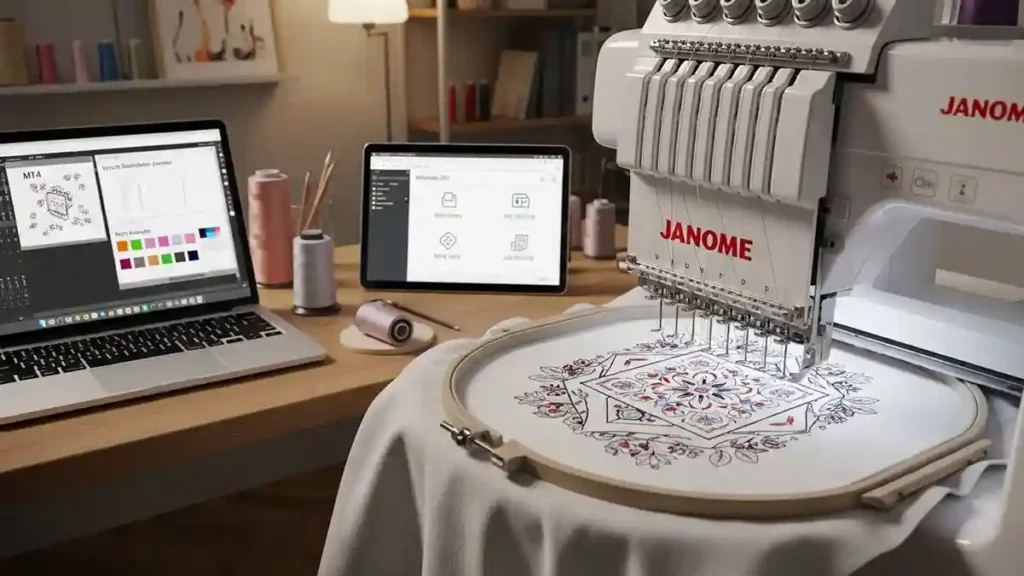
The MB-7 features 7 needles, 800 SPM max speed, and a 9.4×7.9″ embroidery field, priced around $8,999. Its compact size makes it easy to place in small studios, and it pairs smoothly with MT4 software for vector imports and auto-basting. Stitch simulation reduces redraws, noise stays low, and thread control is very stable. For users producing around 150 pieces per day, it comfortably fits the best 6 needle embroidery machine range.
The Memory Craft 5500 adds wireless JEF transfers, 350 built-in designs, and Ink/Stitch job splitting. It performs well on stretch fabrics, though the cap frame is optional and dense satins run at lower speeds. With a 5-year warranty and free US training, Janome remains a strong choice for precision-focused embroidery.
3. Ricoma
Ricoma entered the embroidery market in 2012 as a US-based disruptor, combining Chinese manufacturing with strong Florida and Texas support by 2020. Through flexible financing and live demos, Ricoma helped many producers scale quickly after the post-pandemic boom.
By 2026, the brand projects around 20% growth, driven by AI cloud software, massive embroidery fields, and same-day parts availability. For growing shops focused on speed and volume, a multi needle embroidery machine from Ricoma supports high-output production without slowing workflow.

The MT-1501 features 15 needles, 1,500 SPM max (1,450 sustained), and a large 16×20″ embroidery field (400×500 mm), priced at $17,999. It includes laser guides (±0.3 mm), an included cap frame, and Design Studio V3 software with Wi-Fi DST/EXP editing and estimators.
Chicago embroidery shops report producing up to 500 shirts per day, achieving strong ROI with low thread breakage. The heavy 250-lb industrial frame and auto-trim per color make it a dependable choice for high-volume operations.
The EM-1010 comes with 10 needles, 1,200 SPM, and a 12×18″ field, priced at $12,499. It supports instant Wilcom file loading, Ink/Stitch Wi-Fi integration, and handles 400–600 pieces per day. While the setup is heavier, the machine delivers consistent results and includes a 3-year warranty with 12-month financing.
4. Tajima
Founded in 1944 in Japan, Tajima invented multi-head embroidery in the 1960s and became the factory benchmark by the 1980s. Tajima machines are built for nonstop industrial use, extreme durability, and precise stitch control. By 2026, the brand leads massive embroidery networks with up to 256 heads, supported by Pulse AI and advanced tension systems.
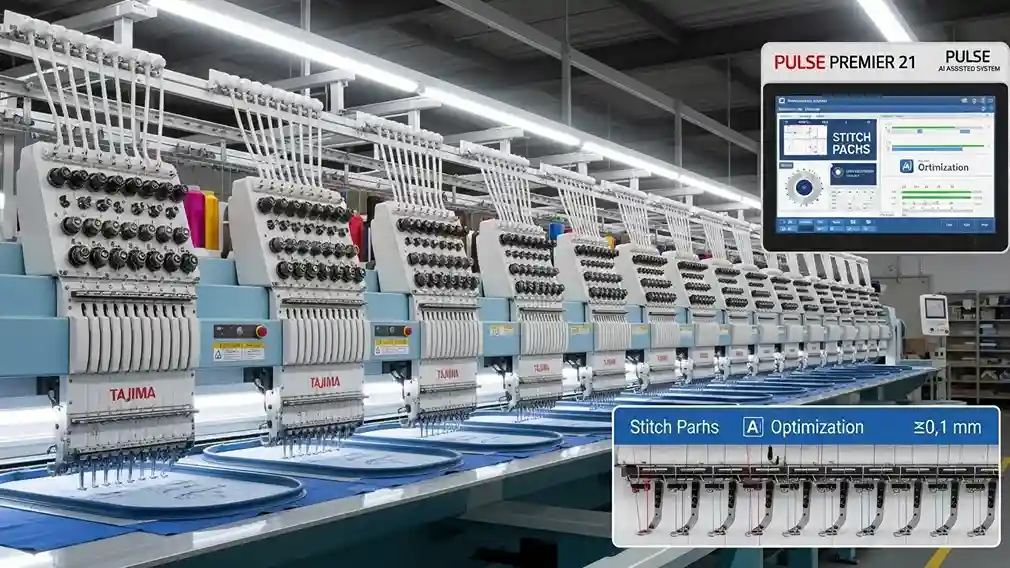
The TMBP-SC model includes 15 needles, runs at 1,200 SPM, and offers a 12×16″ embroidery field, priced around $28,000. With ±0.1 mm accuracy, Pulse Premier 21 software, zero-vibration metal frames, and over 50,000 operating hours, Tajima remains the industrial standard for factories handling continuous production.
5. Melco
Melco launched in the US in 1980 and later evolved into the Amaya system, focusing heavily on automation and job queuing. Instead of only increasing speed, Melco optimized production flow through software-driven management. In 2026, Melco continues growing with JobBoss 2.0 AI and advanced workflow systems.
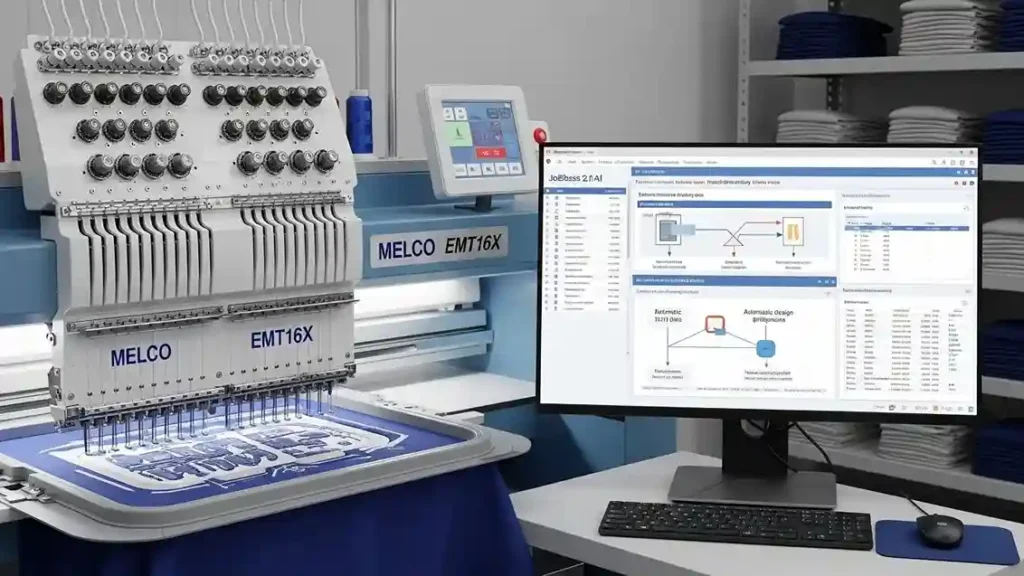
The EMT16X features 16 needles, 1,600 SPM, and a 15.7×16″ embroidery field, priced at $32,000. It supports over 100 queued jobs, automatic split designs, and smooth Wilcom DST integration. With about 600 pieces per day capacity, it suits structured shops that rely on system efficiency rather than manual oversight.
6. Barudan
Barudan was founded in 1946 in Nagoya, Japan by Shiro Yamazaki and gained strong recognition in the 1970s for multi-head embroidery excellence. The brand is known for elite performance on exotic and heavy materials.
In 2026, Barudan continues to grow with NX AI pull compensation and premium installs. For shops dealing with difficult fabrics, a multi needle embroidery machine from Barudan is often chosen for stability and stitch accuracy.

The BNY-403 is a 4-head system with 15 needles per head, running at 1,200 SPM (1,100 sustained) and offering a custom 20×20″ field, priced around $35K+. It uses NX software with ±0.1 mm registry, cast-iron vibration-free frames operating at 58 dB, and rotary hooks optimized for Isacord metallics. Wilcom gradients achieve 99.5% accuracy on leather with 0.3 mm spacing, producing up to 1,000 shirts per head per day. Rated for 50,000+ hours, it’s widely regarded as a best 4 head embroidery machine for demanding commercial work.
7. Avancé
Avancé entered the US market as a budget-industrial alternative and expanded rapidly through Texas and Florida dealers by 2020. Built as a Tajima-style platform at a lower cost, Avancé targets shops that want industrial features without premium pricing. By 2026, the brand projects around 25% growth backed by warranties and dealer support.

The A-1201 features 12 needles, runs at 1,200 SPM, and offers a 14×16″ embroidery field (360×400 mm), priced at $14,999. It includes laser placement (±0.3 mm), auto-trim, a 220-lb frame, and Wilcom DST instant loading with 75% Hatch compensation.
With production around 400+ pieces per day and included cap frames, many shops see ROI within five months, placing it in the best 12 needle embroidery machine category for value-focused buyers.
8. Happy
Founded in 1978 in Tokyo by innovator H. Nishida, Happy pioneered modular head technology in the 1990s, allowing flexible configurations for different jobs. The brand gained strong US traction in the 2000s through reliable Japanese sourcing and versatile frame designs.
By 2026, Happy projects 20% growth driven by app-based modular swaps, Hatch/Wilcom integration, and expanded demos. A multi needle embroidery machine from Happy is often chosen by shops that need adaptability across changing order types.

The HCD-1206 comes with 12 needles, 1,000 SPM max (950 sustained), and a 12×18″ field (300×450 mm), priced around $16,000. It features swappable heads for quick cap-to-flat changes, NX-style software, lightweight 190-lb construction, and smooth digitizing workflows via LAN/USB. With optimized density and low thread breaks, it handles 300–400 pieces per day comfortably, especially for mixed promotional work.
9. Baby Lock
Baby Lock traces its roots to Japan in the 1960s and entered the US market in the 1970s, later transitioning into multi-needle embroidery in the 2000s. The brand focuses on ease of use, stitch stability, and smooth upgrades for users moving from home to small-business production.
By 2026, Baby Lock projects 12% growth driven by AI placement previews and expanded cap accessories. For intuitive workflows, a multi needle embroidery machine from Baby Lock feels approachable and reliable.

The Venture model includes 10 needles, runs at 1,000 SPM (900 sustained), and offers an 8×12.5″ field (200×285 mm), priced around $10,000+. It delivers ±0.4 mm accuracy, smooth USB/Wi-Fi workflows, built-in camera and projector previews, and quiet 65 dB operation. Users report clean results on 150–250 pieces per day, making it ideal for home-to-pro transitions.
10. Bernina
Bernina was founded in 1893 in Switzerland by Karl Friedrich Geiger and entered computerized embroidery in the 1990s, earning a reputation for precision engineering and premium stitch finishes. The brand appeals strongly to boutique digitizers working on luxury fabrics. In 2026, Bernina targets niche growth through long-life components and advanced editing software.

The E 16 PRO features 16 needles, 1,200 SPM max (1,100 sustained), and a 14×20″ field (360×500 mm), priced around $25,000+. It supports oversized hoops, ±0.2 mm placement, stitch simulators, and Wilcom exports that achieve pristine gradients on silks and wools.
With long-life cast components (70,000+ hours) and premium tension control, it supports about 400 pieces per day in high-end studios. For refined production, a multi needle embroidery machine from Bernina emphasizes quality over volume.
11. SWF
SWF originated in South Korea in the 1980s and grew into a value-driven industrial player by the 2000s, offering robust machines for cost-conscious commercial shops. Expanding US distribution and cloud monitoring push steady growth into 2026.

The KX Series offers 15 needles, runs at 1,200 SPM (1,100 sustained), and features a wide 16×18″ field (400×450 mm), priced around $20,000. It prioritizes color registry (±0.3 mm), strong frames for 24/7 shifts, and seamless Wilcom DST sync. With output around 450 pieces per day and solid durability, SWF suits uniform and promotional production.
12. ZSK
Founded in the 1970s in Germany, ZSK advanced automation with expandable multi-head systems for European factories. By the 1990s, it led precision automation and continues to grow through AI job routing and remote diagnostics.

The X-Series supports multi-head configurations up to 20 heads, runs at 1,000 SPM max (950 sustained), and offers custom fields up to 18×20″, priced from $30,000+. With German-engineered hooks, ZSK Commander software, and Hatch/Wilcom compatibility, systems deliver 500+ pieces per day per head and scale efficiently.
13. Husqvarna Viking
Husqvarna Viking dates back to 1872 in Sweden and integrated embroidery into designer-focused machines in the 2000s. The brand blends creative tools with commercial capability, aiming at studios that value versatility.
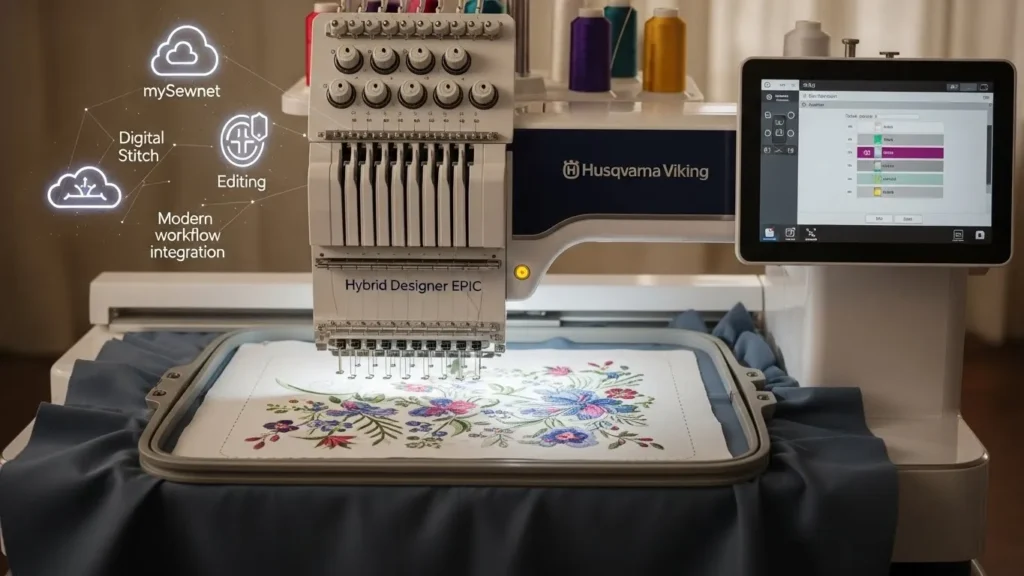
The Hybrid Designer EPIC offers 10 needles, 1,000 SPM, and a 10×14″ field (250×360 mm), priced around $15,000. With mySewnet cloud tools, smooth PES edits, and intuitive controls, it supports about 300 pieces per day, best for creative studios rather than high-volume factories.
14. Juki Tajima
The Juki Tajima collaboration leverages sewing speed with embroidery precision, strengthening US market penetration. Growth into 2026 is driven by cap performance and dense stitch reliability.
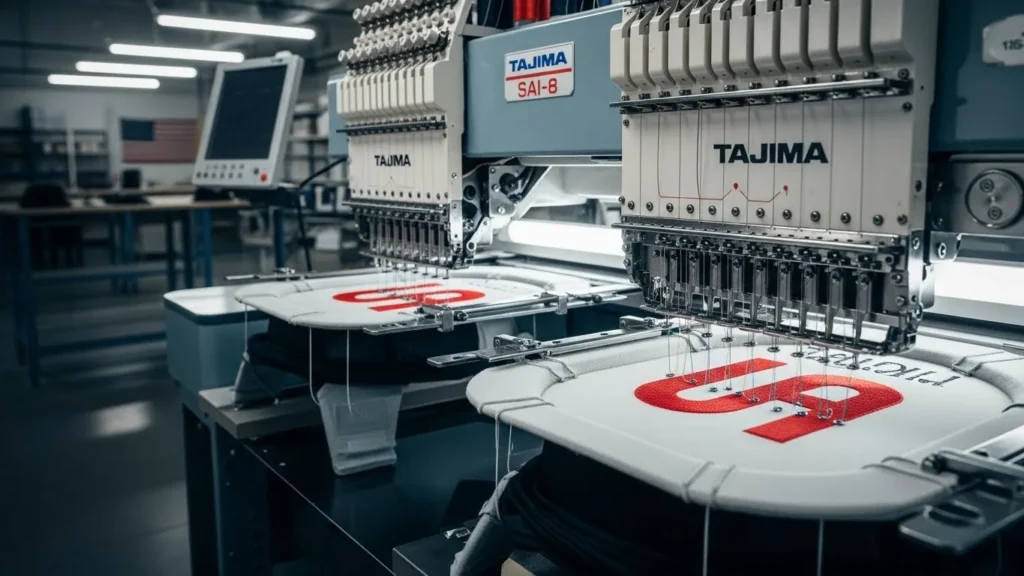
The SAI-8 includes 8 needles, runs at 1,200 SPM, and offers a 15.7×23.6″ field (400×600 mm), priced around $20,000+. It excels on hats with high-density penetration, producing roughly 400 pieces per day on robust frames.
15. Smartstitch
Smartstitch entered in the 2020s targeting beginner commercial users with modern connectivity. Growth continues through Wi-Fi accessibility and simple controls.
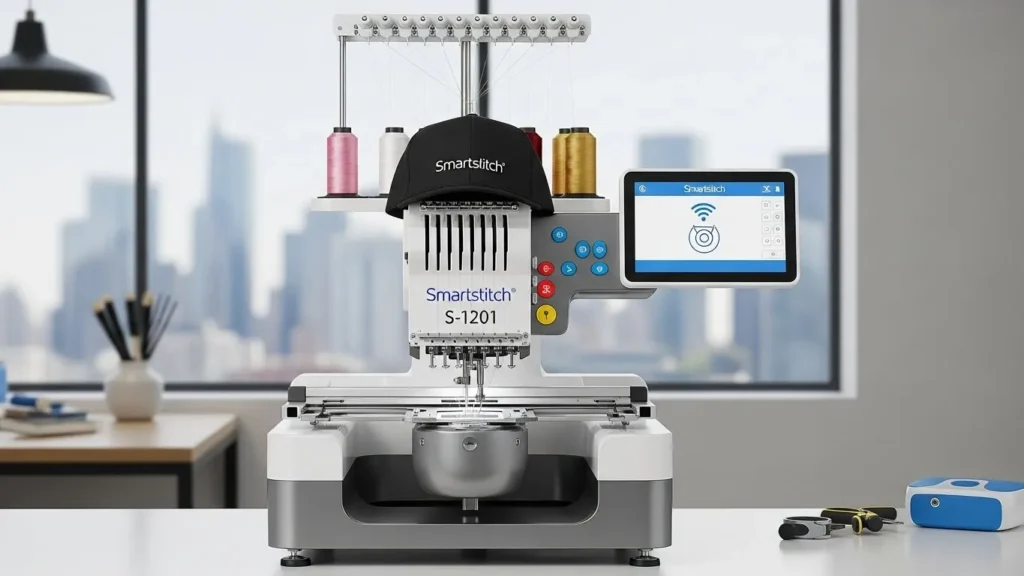
The S-1201 features 12 needles, 1,200 SPM, and a 9.5×12.6″ field (240×320 mm), priced around $12,000. With Wi-Fi transfers, included cap frames, and easy DST handling, it supports about 250 pieces per day for entry-level shops.
Conclusion
Choosing the right multi needle embroidery machine is a major step toward faster production, cleaner stitching, and consistent embroidery results. Throughout this article, we’ve explored leading brands and machines that help businesses handle higher volumes, complex designs, and different fabrics with confidence. However, even the best machine can’t deliver professional results without properly prepared embroidery files.
That’s where professional embroidery digitizing becomes essential. High-quality digitizing ensures correct stitch density, clean paths, smooth color changes, and reduced thread breaks, helping your machine perform at its full potential and protecting your garments from costly mistakes.
ZDigitizing provides professional embroidery digitizing services backed by over 10+ years of experience and an expert digitizing team that understands how different machines, fabrics, and designs work together. Our 24/7 working team and 24/7 customer support ensure fast turnaround and reliable communication.
We guarantee quality on every file, provide a preview before payment, and offer minor edits for free to make sure your design stitches perfectly. Our prices are already lower than the market, and new customers get an exclusive 50% OFF on their first order.
Visit ZDigitizing today, place your first order, get 50% OFF, and experience premium embroidery digitizing quality that helps your embroidery machine deliver flawless results every time.