Choosing the right Janome machine needles can completely transform your stitch quality, embroidery results, and even how smoothly your machine performs over time. The right needle choice can improve embroidery clarity, fabric handling, and overall machine performance. That’s why this guide breaks down needle types, sizes, and uses in a simple, easy-to-follow way. Once you finish reading, you’ll know exactly which needle to use, without guessing, every time you sit down to stitch.

Janome Machine Needles Guide: Types, Sizes, and Uses
Janome-Organ Connection: Why Your Machine Loves Organ Needles?
When you search for Janome machine needles, you’ll often see Organ needles showing up in the results, and that immediately raises a question: Why is another brand appearing when I’m looking for Janome needles? This is a very common confusion, especially for beginners.
The reason is not replacement or compatibility guesswork; it’s an official engineering connection. Janome has a long-term manufacturing relationship with Organ, which means many needles sold for Janome machines are actually produced by Organ under Janome’s technical standards. These needles are designed to match Janome’s stitch timing, hook movement, and fabric control system.
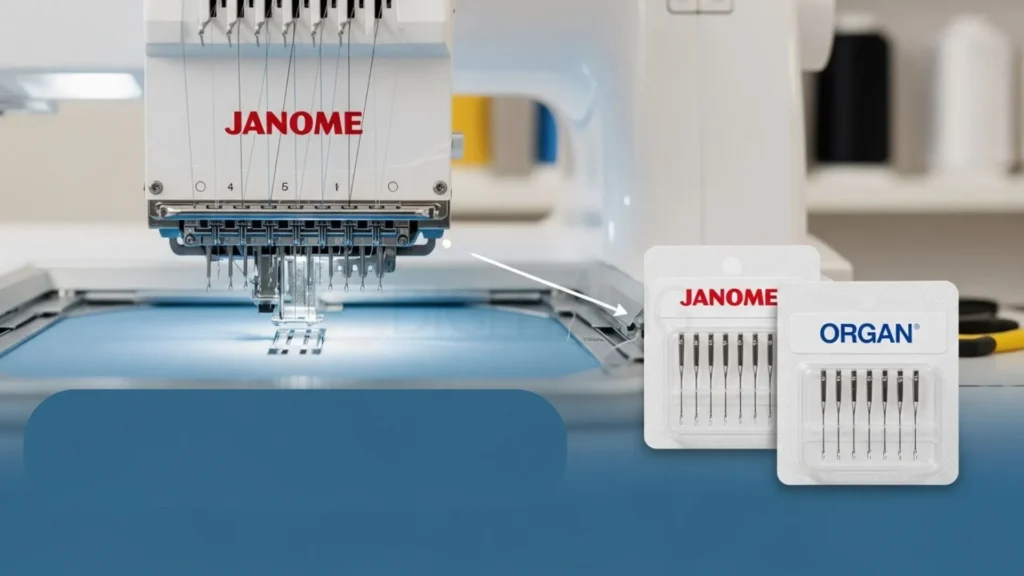
Because of this partnership, Organ needles are engineered to work naturally with Janome machines, giving smoother stitches, fewer skipped stitches, and better overall sewing control. That’s why Organ appears so frequently and confidently recommended.
So when professionals talk about reliable needles for Janome machine use, Organ is mentioned not because it’s “similar,” but because it’s built specifically to support how Janome machines are designed to work.
Anatomy of a Janome Machine Needles
A machine needle isn’t just a simple pointed rod; it’s a sophisticated instrument with several key parts, each playing a vital role in stitch formation.
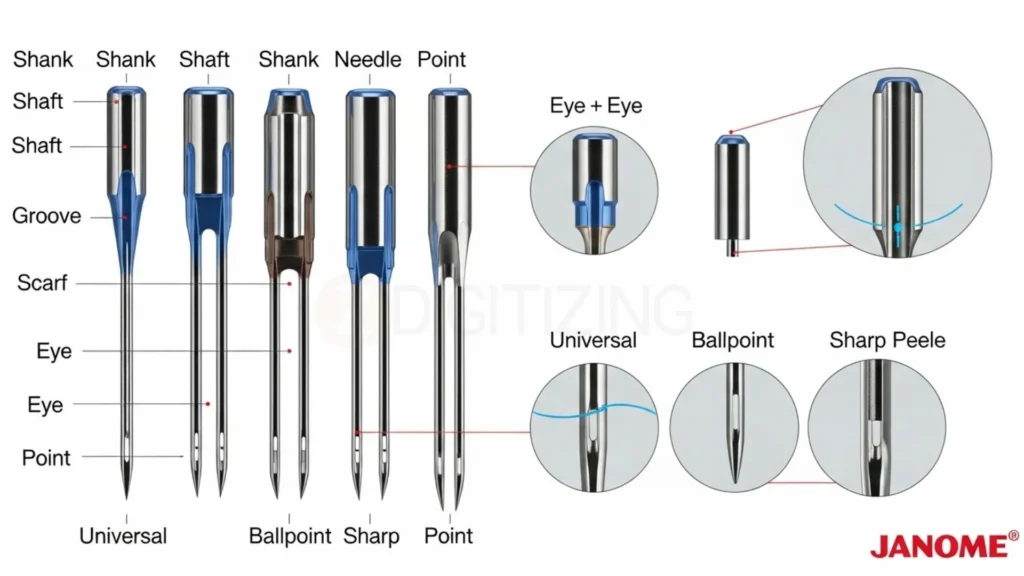
- The Shank: This is the upper part of the needle that inserts into your machine’s needle bar. Janome machines typically use a “flat shank” needle, which has one flat side to ensure it’s inserted correctly and consistently.
- The Shaft: The body of the needle below the shank. Its diameter determines the needle’s size.
- The Groove: A long groove running down the front of the needle, guiding the upper thread smoothly to the eye.
- The Scarf: This is a crucial indentation on the back side of the needle, just above the eye. For Janome machines, the scarf is often deeper, allowing the bobbin hook to pass closely and efficiently pick up the top thread loop, preventing skipped stitches, especially with zigzag stitches or during machine embroidery.
- The Eye: The hole through which the thread passes. Its size is proportionate to the needle’s shaft, accommodating various thread weights.
- The Point: The very tip of the needle, which pierces the fabric. The shape of the point varies greatly depending on the needle type (e.g., sharp, ball point, wedge point).
Understanding these parts helps you diagnose issues and appreciate why specific Janome machine needles are recommended for different tasks.
Decoding the Numbers: How to Read American (8–20) vs. European (60–120) Sizing
Embroidery machine needle sizes can be confusing due to the dual numbering system. However, it’s quite straightforward once you know the correlation:
- European Sizing (60–120): This number directly corresponds to the diameter of the needle shaft in hundredths of a millimeter. So, a size 60 needle has a diameter of 0.60mm, and a size 120 needle has a diameter of 1.20mm. Higher numbers mean a thicker, stronger needle.
- American Sizing (8–20): This system is a more arbitrary scale, but it also reflects the needle’s thickness. A size 8 is very fine, while a size 20 is very heavy-duty.
Both numbers are often printed on the needle package (e.g., 90/14). Generally, smaller numbers (60/8, 70/10) are for lightweight fabrics and finer threads, while larger numbers (100/16, 120/20) are for heavy fabrics and thicker threads.
Using the correct size of Janome machine needles ensures the needle creates an appropriately sized hole for the thread, leading to balanced stitches and preventing fabric damage.
The Color-Coded Tip System (The “Secret Sauce”)
Janome, in conjunction with Organ, has made needle selection even easier with a clever color-coding system, particularly useful for specialized tasks. These color tips quickly identify the needle’s purpose, acting as a secret sauce for achieving specific results, especially important when selecting Janome embroidery machine needles.
Blue Tip (#11): The Best Choice for Embroidery and Delicate Knits

The Blue Tip needle, typically a size 75/11, is a true superstar in the Janome machine needles lineup. It’s often considered the “Holy Grail” for two main reasons:
- Embroidery: Its slightly rounded ball point helps it slip between the fibers of the fabric rather than piercing them, which is crucial for dense embroidery designs. This reduces skipped stitches and fiber damage, leading to cleaner, more professional embroidery. It’s often recommended when you need the best needle for machine embroidery.
- Fine Knits and Delicate Fabrics: For materials like jersey, silk, or interlock, the Blue Tip’s gentle approach prevents runs, snags, and holes. It’s designed to protect the integrity of delicate weaves and knits.
If you’re delving into embroidery with your Janome, keeping a good supply of Blue Tip needles is a must.
Red Tip (#14): Designed to Handle Thick Stitches and Metallic Threads
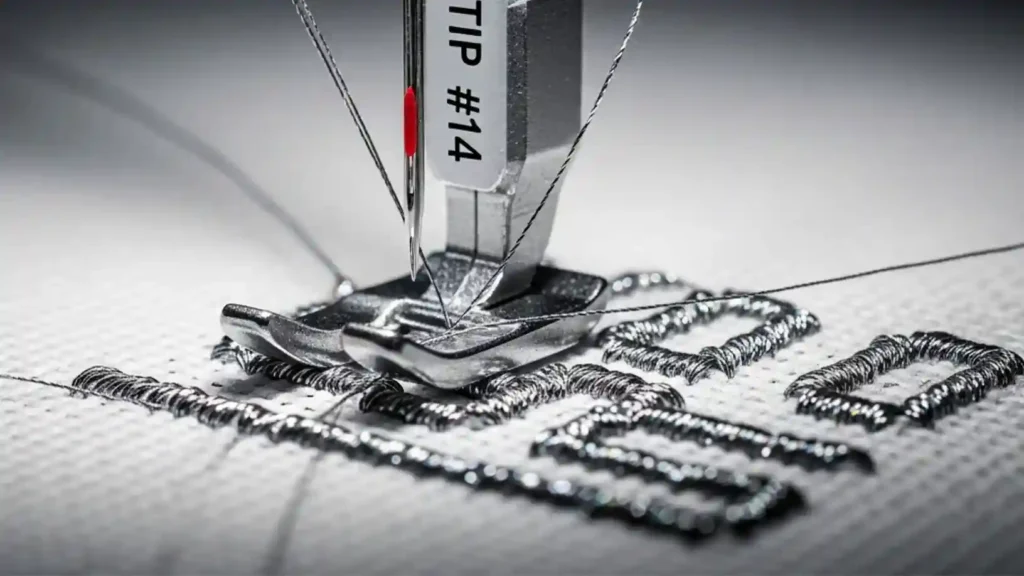
When your embroidery projects demand more power, the Red Tip needle (typically a size 90/14) steps up to the plate.
- Dense Embroidery: For designs with very high stitch counts or multiple layers of appliqué, the Red Tip’s stronger shaft minimizes deflection and breakage. It can withstand the repeated stress of pushing through numerous layers of thread and stabilizer.
- Metallic Threads: Metallic threads, while beautiful, can be notoriously finicky. The Red Tip Janome machine needles often feature a larger eye to reduce friction and shredding of these delicate threads. This larger eye, combined with its strength, makes it an excellent choice for preventing breakage and ensuring smooth passage of metallic or other specialty threads.
Purple Tip (#14): How the Cobra Head Design Prevents Skipped Stitches?
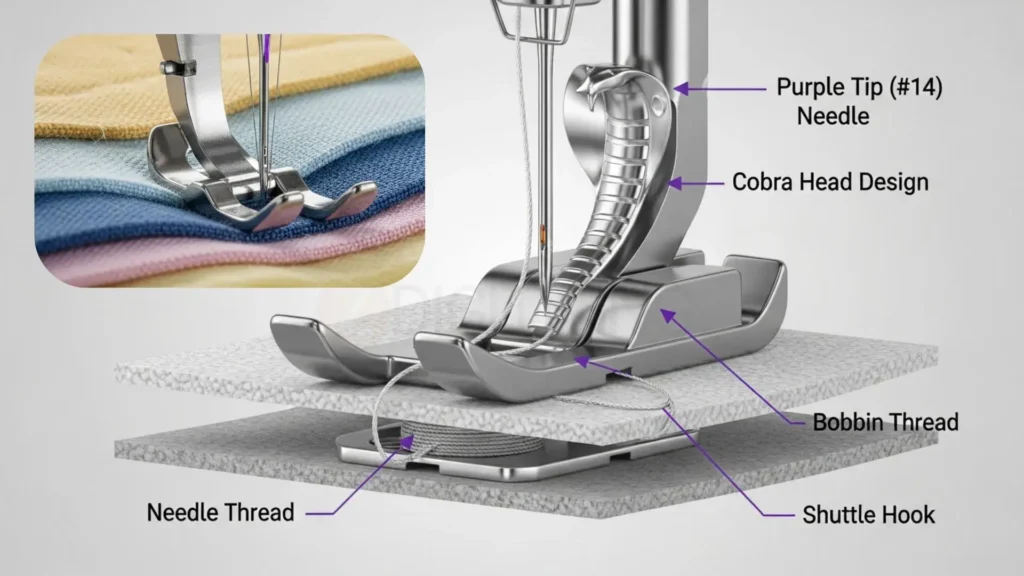
The Purple Tip needle (typically a size 90/14), sometimes referred to as the “Cobra Head” due to its distinctive scarf design, is a game-changer for quilters and anyone working with challenging fabrics prone to skipped stitches.
- The “Cobra Head” Design: This unique feature involves an even deeper and wider scarf area. This enhanced design allows the bobbin hook to pick up the top thread loop more reliably and consistently, even when sewing over thick seams, multiple fabric layers, or batting, which are common in quilting.
- Quilting: For piecing quilt blocks, free-motion quilting, or binding, these Janome machine needles drastically reduce the frustration of skipped stitches. Its ability to navigate bulk with ease makes it an invaluable tool for ensuring every stitch is perfectly formed.
Comprehensive Janome Machine Needles Type Guide
Beyond the color-coded tips, a variety of needle types exist, each engineered for specific fabrics and applications. Choosing the right needle is as critical as selecting the right fabric, ensuring optimal stitch quality and preventing damage to your materials.
Universal: The Everyday Workhorse for Woven Fabrics
The Universal needle is the most common and versatile needle type, making it the everyday workhorse for countless projects.
- Point Type: It features a slightly rounded point that can penetrate most woven fabrics without causing significant damage.
- Best Uses: Ideal for a wide range of woven materials such as cotton, linen, broadcloth, flannel, and light to medium-weight synthetics. If you’re unsure which needle to use for a new project, a universal needle is often a good starting point.
- Common Sizes: Available in a full range of sizes from 60/8 to 100/16, allowing you to match the needle’s thickness to your fabric’s weight.
Ball Point: Essential for Jersey and Interlock (Preventing Fabric “Runs”)
The Ball Point Janome machine needles are specifically designed for knit fabrics, where piercing individual fibers can cause damage.
- Point Type: As its name suggests, it has a more rounded, blunt tip compared to a Universal needle. This tip pushes between the loops of knit fabric fibers rather than piercing them.
- Best Uses: Perfect for jersey, interlock, fleece, sweatshirt fabric, and other loosely woven or knit materials. It prevents the fabric from “running,” snagging, or developing small holes.
- Common Sizes: Available in sizes similar to Universal needles, with 70/10 to 90/14 being popular for most knits.
Stretch: How It Differs from Ball Point (The “Anti-Skip” Needle for Spandex)
While often confused with Ball Point needles, Stretch Janome machine needles have distinct features that make them superior for highly elastic fabrics.
- Point Type: Like ball-point needles, they have a rounded tip to push through knit fibers.
- Key Difference: The primary distinction is their specially designed “eye” and “scarf.” Stretch needles often feature a larger eye and a deeper scarf, which helps prevent skipped stitches when working with fabrics that have significant stretch or rebound, such as Lycra, Spandex, activewear fabrics, and swimsuits. The deeper scarf ensures the bobbin hook can reliably catch the thread loop even as the fabric stretches and recovers. This makes it an excellent needles for Janome machines on stretchy garments.
- Best Uses: Any fabric with a high spandex or elastic content, lingerie, and performance wear.
Denim/Jeans: Piercing Through Heavy Layers Without Needle Deflection
When tackling tough, dense fabrics, the Denim/Jeans Janome machine needles are your strongest ally.
- Point Type: It features a very sharp, strong, and slender point with a reinforced shaft. This design allows it to penetrate multiple layers of heavy, tightly woven fabric without bending or breaking.
- Best Uses: Denim, canvas, duck cloth, heavy twill, and upholstery fabrics. It’s invaluable for hemming jeans or constructing sturdy bags.
- Common Sizes: Typically found in larger sizes, such as 90/14, 100/16, and 110/18, reflecting its heavy-duty purpose. Using a smaller needle on denim will almost certainly lead to bent or broken needles.
Leather: When to Use the Wedge-Shaped Point (and When to Avoid It)
These Janome machine needles are highly specialized tools for a very specific material.
- Point Type: Unlike other needles, which have rounded or sharp points, a Leather needle has a wedge-shaped, cutting point. It functions much like a miniature knife, slicing through the leather rather than piercing it.
- Best Uses: Genuine leather, suede, and some artificial leathers that are too dense for a traditional point.
- When to Avoid It: Never use a Leather needle on woven or knit fabrics! The cutting point will permanently damage the fabric, creating large, visible holes. It’s strictly for leather.
- Common Sizes: Available in heavier sizes, such as 90/14, 100/16, and 110/18.
Topstitch: Accommodating Thick Decorative Threads with Oversized Eyes
It is designed with decorative stitching in mind.
- Point Type: It usually has a very sharp point, similar to a Universal or Microtex needle, for precise stitch placement.
- Key Feature: Its most distinguishing characteristic is its extra-large eye. This oversized eye allows for easy threading of thicker topstitching threads, metallic threads, or multiple strands of regular thread. The larger eye also reduces friction on the thread, minimizing shredding and breakage.
- Best Uses: Decorative topstitching, quilting, and any project requiring heavier, specialty threads to stand out. It’s often chosen for machine embroidery needles that handle thicker threads.
- Common Sizes: Typically found in sizes like 80/12 to 100/16.
Needle Selection Chart According to Fabric Type
Choosing the correct Janome machine needles can significantly impact the quality of your finished project. This chart provides a quick reference to match your needle to your fabric and thread for optimal results.
Fabric Type | Fabric Weight | Recommended Needle Type | Recommended Needle Size (Janome/Organ) | Recommended Thread Type | Key Considerations |
Chiffon, Organza, Silk | Very Light | Universal, Microtex | 60/8, 70/10 | Fine Polyester, Silk | Use smallest possible needle to avoid pulls. Very sharp point for precise piercing. |
Cotton Lawn, Voile | Light | Universal | 70/10, 80/12 | All-Purpose Polyester, Cotton | Good all-rounder for delicate wovens. |
Jersey, Interlock, Fleece | Light-Medium | Ball Point, Stretch (Blue Tip) | 75/11, 80/12 | Polyester, Wooly Nylon (looper) | Ball Point for general knits, Stretch for high elasticity. Prevents skipped stitches and runs. |
Quilting Cotton, Linen | Medium | Universal, Quilting (Purple Tip) | 80/12, 90/14 | Cotton, All-Purpose Polyester | Purple Tip for piecing and quilting through multiple layers. |
Broadcloth, Poplin | Medium | Universal | 80/12, 90/14 | All-Purpose Polyester | Standard choice for everyday woven fabrics. |
Lycra, Spandex, Activewear | Medium-Heavy | Stretch | 75/11, 90/14 | Polyester, Stretch, Wooly Nylon | Essential for high elasticity to prevent skipped stitches and fabric damage. |
Denim, Canvas, Duck | Heavy | Denim/Jeans | 90/14, 100/16, 110/18 | Heavy-Duty Polyester, Topstitch | Strong, sharp point for dense, thick fabrics. Reduces needle breakage. |
Leather, Suede | Heavy | Leather | 90/14, 100/16, 110/18 | Leather, Heavy-Duty Polyester | Wedge point cuts through material. ONLY for leather. |
Terrycloth, Flannel | Heavy | Universal, Ball Point | 90/14, 100/16 | All-Purpose Polyester, Cotton | Ball Point for plush fabrics to prevent snagging. |
Janome Model Compatibility: Does Your Machine Have Specific Needle Limits?
The vast majority of modern Janome domestic sewing and embroidery machines use standard flat-shank needles (130/705H system). This means that virtually all the needle types and sizes discussed in this guide will be compatible with your Janome machine.
Whether you have a basic mechanical model, a sophisticated computerized sewing machine, or a dedicated Janome multi needle embroidery machine, the needle system remains largely the same.
However, there are a few very rare exceptions, typically with antique or highly specialized industrial Janome machines, which might require different shank types. Always consult your machine’s manual if you are unsure.
For most users, the main concern will be choosing embroidery needles and sewing needles appropriate for the fabric and thread, not the machine’s compatibility with the needle’s physical structure. For instance, a Janome 7 needle embroidery machine or a Janome 6 needle embroidery machine will also use these standard needles.
Expert Pro-Tips & Troubleshooting (The Value Add)
Even with the right needle, issues can arise. Knowing how to troubleshoot common problems and implement best practices can save you immense frustration and elevate your sewing skills. Here are some expert insights for your Janome machine needles.
8-Hour Rule: Why (and When) You Actually Need to Change Your Needle?
This isn’t a myth; it’s a golden rule. Your sewing machine needle experiences tremendous friction and stress as it pierces fabric thousands of times per minute.
- Dulling: Even if it doesn’t break, the needle’s point will become dull over time. Dull Janome machine needles struggle to penetrate the fabric cleanly, leading to skipped stitches, fabric damage, and an audible “thump” as it forces its way through.
- Bending: Repeated impact can cause microscopic bending, which can throw off stitch formation.
- The Rule: A good guideline is to change your needle every 8-10 hours of actual sewing time. For big projects, this might mean changing it multiple times. For occasional sewers, it could be less frequent, but if you notice any issues, a fresh needle is always the first (and often the only) fix needed.
Thread Shredding Solutions: Matching Thread Weight to Eye Size
If your thread is constantly shredding, breaking, or fraying, the needle is often the culprit.
- Too Small an Eye: If the needle’s eye is too small for the thread weight, the thread experiences excessive friction as it passes through, leading to heat buildup and breakage. This is common with specialty threads.
- Solution: Use a needle with a larger eye. Topstitch needles are specifically designed for this purpose, but a larger size Universal or Embroidery needle can also help. Ensure the thread moves freely through the eye.
- Damaged Eye: A burr or rough spot inside the needle’s eye can also shred thread. If swapping sizes doesn’t work, replace the needle.
- Quality of Thread: Sometimes, the thread itself is low quality. Try a different brand of thread to rule this out.
Note: This is common with specialty threads. To avoid these issues, many professionals rely on professional embroidery digitizing services of ZDigitizing to ensure their designs are compatible with standard needle and thread setups.
Safe Disposal: How to Manage “Sharps” in the Sewing Room?
Used Janome machine needles are sharp and can pose a hazard.
- Dedicated Container: Never throw used needles directly into the trash. Keep a small, puncture-proof container (like an old hard plastic pill bottle with a lid, or a purpose-built “sharps” container) next to your machine.
- Labeling: Label it clearly “Used Needles” or “Sharps.”
Disposal: Once full, tape the lid securely and dispose of it according to local waste guidelines. Some areas have specific sharps disposal programs.
Conclusion
Using the right Janome machine needles plays a big role in how clean, smooth, and professional your sewing and embroidery results look. When you understand needle types, sizes, and how they work with your Janome machine, you avoid common problems like skipped stitches, thread breaks, and uneven embroidery. Small choices, like selecting the correct needle, make a big difference in the final quality of your work.
But great embroidery does not depend on needles alone. Even with the best setup, your results will only be as good as your design file. That’s why professional digitizing is so important. Clean stitch paths, balanced density, and proper sequencing all come from expert preparation, not guesswork. This is especially true for detailed logos and complex embroidery designs.
ZDigitizing helps you get those professional results by offering expert embroidery digitizing services along with logo digitizing for embroidery and vector art services. With over 10+ years of experience, their skilled digitizers work 24/7 and provide 24/7 customer support to assist you anytime. They guarantee quality, provide a preview before payment, and offer free minor edits so your design is exactly right. Their prices are already lower than the market, and you also get an exclusive 50% OFF on your first order.
Visit ZDigitizing today, place your first order, and experience high-quality embroidery digitizing that takes your projects to a truly professional level.