When asking how long does embroidery take, the answer for a small machine-embroidered logo is usually minutes rather than hours. A simple design may stitch in around 5–15 minutes, while a large jacket-back design can take 1–3 hours or more. Hand embroidery takes considerably longer, and a professional order may need several days for digitizing, preparation, stitching, finishing, and delivery.

The actual time depends on stitch count, embroidery machine speed, fabric, thread changes, and the amount of preparation required. A machine’s stitching time is also different from the total time needed to complete a custom embroidery order.
How Long Does Embroidery Take? Key Factors & Timeline
Quick Summary: Average Machine Stitching Times
Item Type | Average Stitch Count | Machine Stitching Duration | Total Production Setup Buffer |
Small Chest Logo | 5,000 – 8,000 stitches | 5 – 12 minutes | + 5 – 10 minutes |
Custom Hat / Cap | 6,000 – 12,000 stitches | 15 – 25 minutes | + 10 – 15 minutes |
Embroidered Polo/Shirt | 7,000 – 10,000 stitches | 10 – 15 minutes | + 5 – 10 minutes |
Jacket Back Design | 50,000 – 100,000 stitches | 1 – 3 hours | + 20 – 30 minutes |
How Is Embroidery Time Calculated?
The simplest way to estimate machine embroidery time is to divide the design’s stitch count by the machine’s stitches per minute (SPM). This gives the approximate running time, not the complete embroidery completion time.
Estimated stitching time = Stitch count ÷ Machine speed
For example, a 10,000-stitch design running at 800 SPM would take approximately 12.5 minutes of raw stitching time.
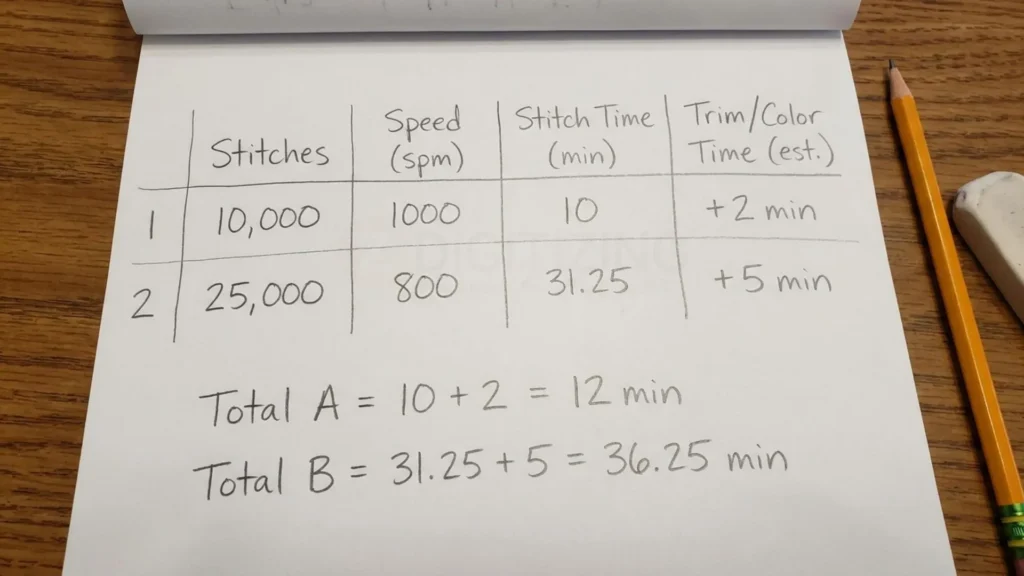
However, the machine does not stitch continuously at its maximum speed. Trims, thread changes, movement between design sections, and slower areas add time to the actual machine embroidery duration.
A practical estimate is:
Actual stitching time ≈ Raw stitching time + approximately 25–40% for production interruptions
The added time varies by machine, design, and setup. A simple one-color logo may need only a small adjustment, while a dense multi-color design may require considerably more.
Example: A Small Logo
A 7,000-stitch logo running at 800 SPM:
- Raw stitching time: approximately 8.75 minutes
- With trims, color changes, and movement: approximately 11–12 minutes
- Additional setup and finishing: separate from the machine’s stitching time
This explains why a design advertised as “10 minutes” may take longer to complete as a finished garment.
Example: A Large Jacket-Back Design
A 50,000-stitch design running at 1,000 SPM:
- Raw stitching time: approximately 50 minutes
- With production interruptions: approximately 65–75 minutes
- Additional hooping, thread preparation, and finishing: separate from stitching
A larger design may also require slower speeds if the fabric is thick, the design is dense, or the machine needs to work through difficult areas.
Why Does Embroidery Take So Long?
When people ask why does embroidery take so long, they often assume the machine runs at one constant speed from the first stitch to the last. In practice, several stages affect the final time.

Stitch Count
Stitch count is one of the biggest influences on machine embroidery duration. A small logo with 5,000 stitches may finish much sooner than a detailed design containing 50,000 stitches, even if both are embroidered on the same garment.
More stitches generally mean:
- Longer machine running time
- More thread consumption
- More opportunities for trims and thread changes
- Greater chance of needing slower speeds
- More time spent checking dense areas
Design size alone does not determine duration. A large, lightly stitched design may take less time than a smaller design packed with dense stitching.
Embroidery Machine Speed
The machine’s SPM rating affects the theoretical stitching time, but the highest available speed is not always the best setting.
A machine may slow down when working with:
- Thick fabrics
- Stretch materials
- Dense designs
- Metallic thread
- Multiple layers
- Caps and other curved surfaces
For example, a machine running at 1,000 SPM can theoretically stitch 10,000 stitches in 10 minutes. A machine running at 500 SPM would need approximately 20 minutes for the same number of stitches before adding trims and other interruptions.
Consequently, the actual average embroidery time reflects these necessary operational slowdowns rather than theoretical top speed.
Thread Colors and Trims
Every additional thread color can introduce a stop, thread change, or trim. A multi-color design may take longer than a one-color design with the same stitch count.
Multi-needle commercial machines can reduce some color-change delays because multiple threads are already loaded. Single-needle machines may require more manual thread changes.
Fabric and Design Difficulty
A stable cotton shirt may allow a machine to run efficiently, while fleece, towels, denim, or a structured cap may require additional support and slower settings.
The same design can therefore have different custom embroidery time estimates depending on where it is being stitched.
Number of Items
The time required for one embroidered item is not the same as the time required for a bulk order. A single shirt may need only a few minutes of stitching, but 100 shirts still require repeated hooping, thread checks, inspection, and finishing.
Commercial multi-head machines can embroider several items at once, which improves production efficiency. However, the total embroidery processing time still depends on the number of pieces, machine capacity, and how much preparation each item needs.
Preparation and Finishing
The machine’s running time is only one part of the process. Hooping, attaching stabilizer, loading thread, positioning the design, and checking the finished embroidery all add to the total.
Preparation may take longer when working with:
- Caps and curved surfaces
- Fleece or towels
- Thick jackets
- Multiple fabric layers
- Difficult embroidery placements
- Designs requiring special stabilizers
Finishing may include trimming excess thread, removing backing, checking alignment, and inspecting the embroidery for defects. These steps are important because a design that stitches quickly is not necessarily ready to deliver immediately.
How Long Does It Take to Embroider a Hat, Shirt, or Logo?
The answer depends on the design and machine, but item-specific estimates help make embroidery completion time easier to understand.
How Long Does It Take to Embroider a Hat?
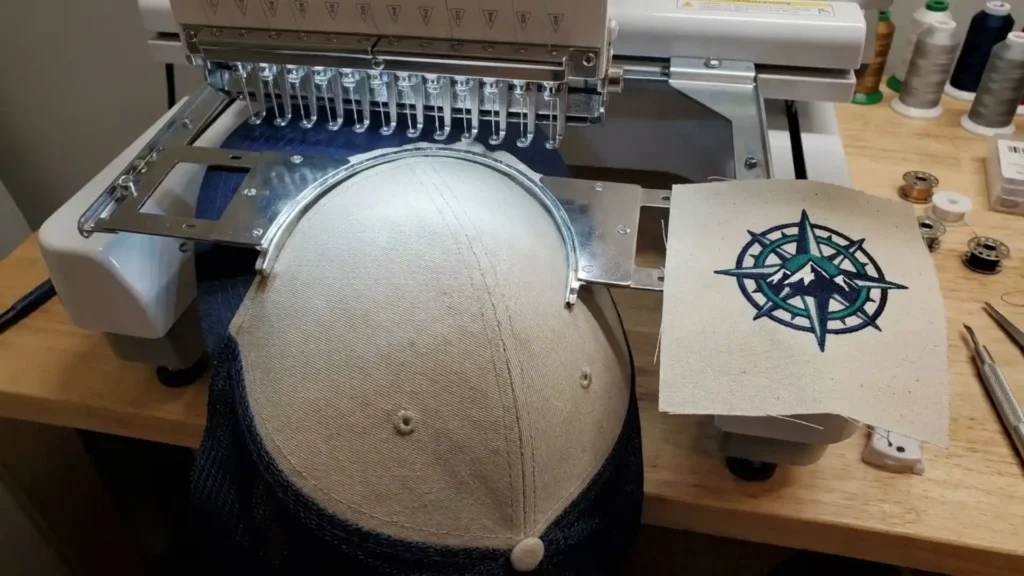
When estimating how long does it take to embroider a hat, a standard cap requires approximately 15–25 minutes of stitching for a simple design. Adding puff 3d embroidery or structured cap framing increases this time due to slower machine speeds and foam placement. Caps often require slower settings because of their curved surface, special framing, and the possibility of fabric movement.
The total time may be longer when the hat requires:
- Special cap framing
- Additional stabilizer
- Multiple thread colors
- Dense lettering
- Careful positioning
- Extra inspection after stitching
A simple logo on a structured cap may finish faster than a dense design covering a larger area.
How Long Does It Take to Embroider a Shirt?
When determining how long does it take to embroider a shirt, a small left-chest logo takes approximately 10–15 minutes of stitching when the design contains around 7,000–10,000 stitches and the machine is running at a suitable speed.
A shirt with a larger or denser design may take considerably longer. Stretch fabric, fleece, and delicate garments can also require additional preparation and slower stitching.
The average embroidery time for a shirt should therefore be based on the actual design rather than the garment alone.
How Long Does It Take to Embroider a Logo?
When evaluating how long does it take to embroider a logo, a simple 3–4-inch logo may take approximately 5–15 minutes if it contains fewer than 8,000 stitches and uses limited colors.
A dense or multi-color logo may take 20–40 minutes or more, particularly when it includes:
- Small lettering
- Detailed outlines
- Several thread colors
- Dense fill stitches
- Multiple trims
- Specialty effects
The number of stitches is usually more useful for estimating how long does embroidery take than the logo’s physical dimensions alone.
How Long Does It Take to Embroider a Jacket Back?
A large jacket-back design may take approximately 1–3 hours or more of machine stitching. Designs containing 50,000–100,000 stitches can require substantial machine time, especially when the fabric is thick or the design is dense.
Jacket embroidery may also need:
- Careful hoop placement
- Strong stabilizer support
- Slower speed through thick areas
- Additional thread changes
- Inspection around seams and bulky sections
A large design does not always require the same amount of time. Stitch count, density, fabric, and machine settings can change the estimate significantly.
How Long Does Large or Complex Embroidery Take?
Large or complex machine embroidery may take 2–5 hours, depending on the design and material. Hand embroidery can take 15–30 hours or more for a similarly detailed project.
Complexity increases time when the design contains many small details, dense fills, multiple colors, specialty stitches, or difficult placement requirements.
How Long Does Hand Embroidery Take?
Hand embroidery time is much longer than machine embroidery because every stitch is created manually. A small patch may take 1–3 hours, while a large or highly detailed design can take 15–30 hours or more.
A rough estimate of 150–250 stitches per hour is sometimes used for hand embroidery, but this varies greatly with the stitch type, skill level, fabric, and design complexity.
For example, 10,000 hand stitches at approximately 200 stitches per hour would equal around 50 hours of stitching. This is only a mathematical estimate; actual projects may take longer because of thread changes, repositioning, planning, and finishing.
Hand embroidery is often chosen for its craftsmanship and artistic detail rather than speed. Machine embroidery is generally more practical when a design must be reproduced consistently across many garments.
What Is the Difference Between Stitching Time and Order Turnaround?
A machine may complete the stitching in 15 minutes, but the complete order can take several days. This is because embroidery turnaround time includes more than the time the needle is moving.
Stage | What it includes | Typical impact |
Digitizing | Converting artwork into a machine-readable stitch file | Hours to days, depending on complexity |
Artwork approval | Reviewing and approving the design | Depends on response time |
Preparation | Hooping, stabilizer, thread loading, and positioning | Minutes per item |
Stitching | Actual machine embroidery | Minutes to hours |
Finishing | Trimming, backing removal, inspection, and packing | Minutes per item |
Delivery | Shipping or collection | Depends on the service |
This distinction explains why a service may quote a longer embroidery turnaround time even when the actual stitching is relatively short.
Digitizing Time vs. Production Time
Machine embroidery digitizing converts artwork into a stitch file such as DST or PES. It does not mean the design has already been embroidered on the garment.
A simple digitizing job may take several hours, while a complex logo or specialty design may require more time for stitch planning, testing, and revisions. Actual production begins only after the file is ready and approved.
For example:
- Digitizing: Approximately 2–24 hours, depending on complexity and service tier.
- Production: Minutes to hours per item, depending on stitch count and machine speed.
- Full order: Includes preparation, stitching, finishing, and delivery.
Utilizing wholesale embroidery digitizing services in USA or professional digitizing partners streamlines file preparation, ensuring optimized stitch paths that minimize production bottlenecks on the shop floor.
What Makes One Embroidery Order Faster Than Another?
When analyzing how long does embroidery take across different garments, two jobs featuring the same logo can require vastly different production timelines. A small design on a flat cotton shirt runs smoothly, while the same artwork on a cap or outerwear requires reduced speeds and specialized framing.

Design Size Is Not the Same as Stitch Count
A large outline design may contain relatively few stitches, while a smaller filled logo can contain thousands more. This is why the physical size of an embroidered logo does not always predict its embroidery completion time.
A design with:
- Light outlines may stitch quickly.
- Open lettering may require less time than filled lettering.
- Dense satin or fill stitches may take longer.
- Small detailed areas may require slower machine movement.
- Multiple overlapping sections may add trims and thread changes.
When estimating how long does embroidery take, the stitch count is usually a better starting point than the design’s width and height.
Why the Same Logo Takes Longer on Some Garments
The garment affects both machine settings and preparation. A flat, stable fabric may be straightforward to hoop, while a curved or bulky item can require more careful positioning.
For example:
- A shirt may need standard hooping and stabilizer.
- A cap may require a special frame and slower stitching.
- A jacket may contain seams, lining, or thick sections.
- A towel may need support to prevent stitches from sinking.
- Stretch fabric may require additional stabilization and controlled movement.
This is why custom embroidery time should be estimated according to the actual garment and placement, not just the artwork.
How to Estimate the Time for a Bulk Embroidery Order
For a bulk order, calculate the approximate stitching time per item first, then account for the number of garments and the production setup.
For example, if one 10,000-stitch logo takes approximately 15 minutes of actual machine time:
- 10 items require around 150 minutes of stitching.
- 50 items require around 750 minutes of stitching.
- 100 items require around 1,500 minutes of stitching.
These figures represent machine runtime only. They do not include hooping, thread preparation, inspection, or other production tasks.
A commercial multi-head machine may complete several garments simultaneously, so the total working time can be shorter than running every item individually. However, the order still requires preparation and quality checks.
Why Bulk Orders May Not Be Ready Immediately
A large order is not always delayed because the machine is slow. The production team may also need to:
- Confirm garment sizes and quantities
- Check artwork approval
- Prepare the correct hoops
- Organize thread colors
- Test the design
- Inspect completed pieces
- Rework items that do not meet the required standard
For this reason, a realistic embroidery turnaround time should include the complete workflow rather than only the number of minutes shown on the machine.
What Should You Ask an Embroidery Service Before Ordering?
If you need embroidery for an event, uniform order, or product launch, ask for a timeline based on your actual design and quantity.
Useful questions include:
- How many stitches does the design contain?
- Is the quoted time for stitching only or the complete order?
- Does the estimate include digitizing and artwork approval?
- Are the garments already available?
- Will the design be tested before production?
- What is the expected completion date?
- Is rush service available if the deadline changes?
- Are setup, finishing, and delivery included in the quote?
These questions help prevent confusion between machine embroidery time and the time required to receive finished garments.
When a Rush Order Makes Sense
Rush service may be useful when the artwork is already approved, garments are available, and the provider has production capacity. It is less predictable when the design still needs major changes or the garments have not arrived.
A rush request should therefore include the exact deadline, item quantity, garment type, design placement, and whether the artwork is ready for production.
A Practical Way to Plan Your Embroidery Deadline
Start with the design and garment, then estimate the stitching time using the stitch count and machine speed. Add preparation and finishing time, and allow extra time for approval, testing, or unexpected production issues.
For a professional order, it is safer to plan around the provider’s quoted embroidery turnaround time rather than assuming that a short machine runtime means the entire order will be completed the same day.
If the order is especially detailed, includes several garment types, or uses specialty effects, request a production estimate before confirming the deadline. This gives the embroidery service enough information to provide a realistic timeline instead of a generic promise.
How Much Time Should You Allow for a Custom Embroidery Order?
When planning custom embroidery, allow time for more than the machine’s running time. The design, garment type, quantity, and finishing requirements all affect the final schedule.
For a small, straightforward order, production may be completed within a short working session. Larger orders, detailed designs, or multiple garment types need additional time for preparation, testing, and quality checks.
If you have a fixed deadline, share the following details before placing the order:
- The artwork and design dimensions
- The type and quantity of garments
- The embroidery placement
- The required completion date
- Whether the artwork is ready for production
- Any special requirements, such as metallic thread or puff 3d embroidery
Providing these details helps the embroidery service estimate the actual workload and avoid unexpected delays.
Conclusion
The answer to how long does embroidery take depends mainly on stitch count, machine speed, fabric, design complexity, and order quantity. A small logo may take only a few minutes to stitch, while a detailed jacket-back design or bulk order can require several hours of production and additional preparation.
For the most accurate timeline, ask for an estimate that includes stitching, setup, finishing, and delivery rather than relying only on the machine’s running time. At ZDigitizing, expert artwork preparation ensures your files are optimized for smooth, reliable machine performance, and with new customers receiving 50% off their first order, you can easily experience faster runtimes and precise stitch quality on your next project.