Choosing the right embroidery machine can be confusing, especially when a Toyota embroidery machine is often recommended but no longer manufactured. So, is it still worth buying in 2026, or should you look for newer options? These legendary Japanese units remain a top choice for professionals today. They offer incredible durability and stitch quality without the high price of modern equipment. Because they are no longer in production, you must look for well-maintained used models.

This guide explains how to find the best machines, maintain their parts, and use modern software to keep these powerful workhorses running perfectly in 2026.
Toyota Embroidery Machine Guide (2026): Review, Features, Pros & Alternatives
Why Choose Toyota Embroidery Machines in 2026?
Toyota has built a solid name in embroidery since the 1970s. These machines stand out for their tough build and steady work output. In 2026, updates focus on energy savings and easier controls, making them perfect for busy workshops.
Businesses pick Toyota for low breakdown rates. One owner shared, “My Toyota 830 ran 10 years with basic care.” They handle thick fabrics like denim or leather without fuss. Speed hits 1000-1200 stitches per minute (SPM), boosting daily output by 20-30%.
Here’s why Toyota embroidery machine shines:
- Durability: Metal frames resist wear, unlike plastic-heavy rivals.
- Value: Affordable parts keep repair costs down.
- Versatility: Works for logos, patches, or large designs.
- 2026 Edge: New models cut power use by 15%, great for green shops.
For beginners, Toyota offers simple setups. Pros love the precision. Businesses see quick ROI from high uptime. If reliability tops your list, Toyota delivers.
This brand beats many in long-term tests. Forums like EmbroideryTalk praise their “set-it-and-forget-it” style. In a market full of flashy new machines, Toyota keeps it real and reliable.
Popular Toyota Embroidery Machine Models
Toyota offers a range from entry-level to heavy-duty. Each model fits different needs. Let’s break them down.
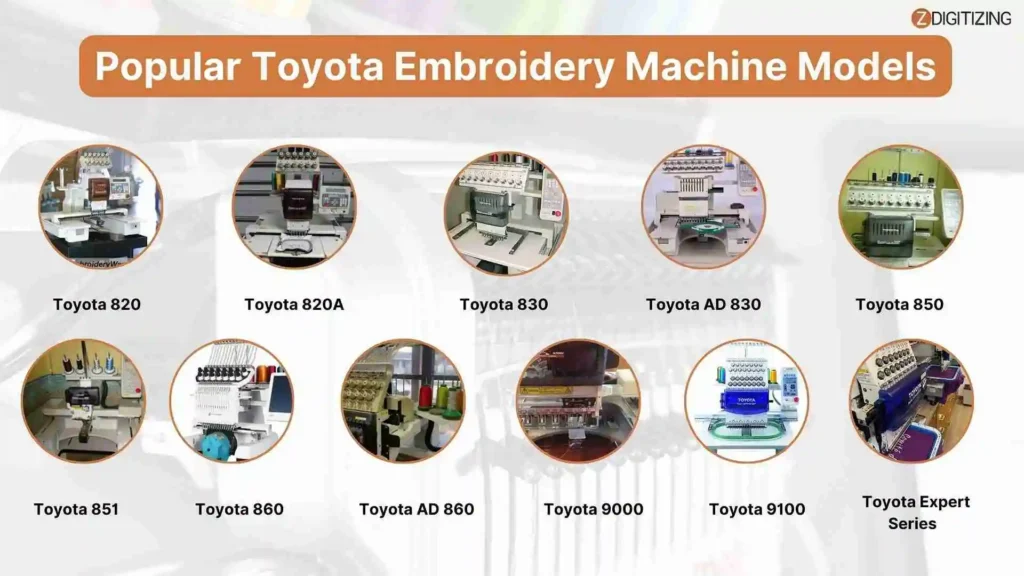
- Toyota 820
- Toyota 820A
- Toyota 830
- Toyota AD 830
- Toyota 850
- Toyota 851
- Toyota 860
- Toyota AD 860
- Toyota 9000
- Toyota 9100
- Toyota Expert Series (ESP models)
1. Toyota 820

The Toyota 820 embroidery machine is a classic single‑head, 6‑needle embroidery machine that many small shops and beginners still use. It may not be the fastest by modern standards, but it is very tough and reliable.
- Needles / Heads: 6 needles, 1 head.
- Typical use: Custom caps, small garment orders, basic logos on shirts and bags.
- Key features:
- Removable table top so you can attach cap frames or other tubular attachments.
- Uses a cap‑style thread‑change system, which is simple and easy to maintain.
- Moderate speed, usually around 800–900 stitches per minute, which is enough for small‑volume work.
- Basic control panel, but very straightforward for training staff.
- Who it’s good for: Small businesses or home‑based embroiderers who want an affordable, easy‑to‑repair industrial Toyota embroidery machine that will keep running for years.
2. Toyota 820A

The Toyota 820A is a slightly updated version of the 820. It keeps the same 6‑needle, single‑head design but improves the control panel and small internal parts.
- Needles / Heads: 6 needles, 1 head.
- Typical use: Similar to the 820 – light to medium‑volume embroidery on caps, small shirts, and basic patches.
- Key features:
- Improved control layout and clearer feedback for the operator.
- Still uses the cap thread‑change system, so threading and maintenance stay simple.
- Slightly more refined motor and frame tuning, which reduces vibration over long runs.
- Who it’s good for: Anyone who likes the 820 concept but wants a version that feels a bit more modern and easier to operate daily on a Toyota embroidery machine.
3. Toyota 830

The Toyota 830 embroidery machine is a classic 9‑needle, single‑head industrial embroidery machine that became very popular in the 1990s and is still widely used in second‑hand markets.
It is a step up from the 820 in terms of embroidery capacity because it supports more colors.
- Needles / Heads: 9 needles, 1 head.
- Typical use: Caps, small‑ to medium‑size garment runs, sports uniforms, and basic patches.
- Key features:
- Speed up to about 1000 stitches per minute, which gives a noticeable productivity boost over the 820.
- Uses a cap system for up to 9 thread colors, so you can embroider more colorful designs without changing the frame.
- Has a 25‑pin serial port for connecting to a PC (older style), and many shops add USB “black box” adapters to make file transfer easier.
- Simple, heavy‑duty frame that handles thick fabrics like denim and jackets well.
- Who it’s good for: Small shops and home‑based embroiderers who want a reliable, low‑cost industrial Toyota embroidery machine with more colors than the 820.
4. Toyota AD 830

The Toyota AD 830 is an updated or modernized version of the original 830. It keeps the same 9‑needle, single‑head concept but adds a few improvements in controls and electronics.
- Needles / Heads: 9 needles, 1 head.
- Typical use: Same as the 830, caps, small‑ to medium‑size orders, and basic‑ to medium‑complex designs.
- Key features:
- Similar top speed, around 1000 stitches per minute.
- Improved control panel with better display and easier menu navigation.
- Slightly more sophisticated diagnostics, so it is easier to spot problems before they become big issues.
- Still designed to be easy to service and repair, which is important if you are buying used.
- Who it’s good for: Businesses that want the reliability of the 830 while using a modern Toyota embroidery machine that feels more comfortable for daily operation.
5. Toyota 850

The Toyota 850 embroidery machine is a mid‑range, multi‑head Toyota Industrial embroidery machine that sits between beginner‑level and high‑end industrial models. It is often sold as the “Expert 850” or “850 ESP,” which is essentially the same core machine with updated electronics.
- Needles / Heads: Typically 6–10 heads, with 15–18 needles per head.
- Typical use: Medium‑size shops handling uniforms, bags, corporate orders, and small‑volume runs.
- Key features:
- Speed up to about 1200 stitches per minute on each head.
- “Mecha‑Tronics” or automatic color‑change system, which reduces downtime between colors and keeps production smooth.
- Commercial‑grade embroidery area per head, usually around 300 x 460 mm, which is large enough for most chest and back designs.
- Modular design, so you can run several Toyota embroidery machines in a line without one stopping the whole line.
- Good thread break detection and basic bobbin monitoring, which helps reduce wasted time.
- Who it’s good for: Growing shops that need more capacity than a single‑head embroidery machine Toyota, but do not yet need a full 12‑head factory‑style setup.
This machine is a strong choice if you want stable production with good quality, especially for detailed logo work like left chest embroidery digitizing.
6. Toyota 851

The Toyota 851 embroidery machine is one of the most popular multi‑head models in the Toyota Industrial machine range. Many embroiderers see it as the sweet spot between power, reliability, and price.
- Needles / Heads: Typically 6–12 heads, with 15–18 needles per head.
- Typical use: Medium‑ to large‑volume shops doing uniforms, jackets, bags, and complex logos.
- Key features:
- Speed up to 1200 stitches per minute on each head.
- Automatic thread trimming and advanced color‑change system, so you spend less time changing threads manually.
- Thread break sensors and bobbin counters that help keep production running with fewer interruptions.
- Large embroidery area per head, which is great for big chest designs and wide panels.
- Very stable frame and smooth motor system, so the machine can run for long hours without shaking.
- Who it’s good for: Established embroidery businesses that want a reliable, high‑capacity Toyota embroidery machine that can handle daily heavy use without constant breakdowns.
7. Toyota 860

The Toyota 860 embroidery machine is a high‑capacity, multi‑head Toyota Industrial machine designed for serious production environments. It is built for shops that need maximum output.
- Needles / Heads: Commonly 10–12 heads, with 12–15 needles per head.
- Typical use: Heavy‑volume shops, factories, and any operation that runs 24/7 or close to it.
- Key features:
- Speed up to 1200 stitches per minute on each head.
- AC servo motors that give smooth, low‑vibration stitching and better control over fine details.
- Large embroidery area per head, usually around 460 x 300 mm, which is ideal for big logos and wide panels.
- Functions like pattern rotate, mirror, repeat, and offset help operators arrange designs quickly and efficiently.
- Power‑loss memory backup keeps your work safe if the electricity goes out.
- Who it’s good for: Large operations that need to process hundreds or thousands of pieces per day using a powerful Toyota embroidery machine.
8. Toyota AD 860

The Toyota AD 860 is an updated version of the 860 with refined electronics and a more modern control panel, while keeping the same powerful multi‑head structure.
- Needles / Heads: 1–12 heads (configurable), with 12–15 needles per head.
- Typical use: Same as the 860 – heavy‑volume industrial embroidery in factories and big shops.
- Key features:
- Modern control panel with clearer menus, better diagnostics, and easier tuning options.
- Still runs at 1200 stitches per minute with the same heavy‑duty frame.
- Designed to be easier to integrate into modern production lines, especially if you are upgrading from older 860 models.
- Who it’s good for: Factories and large shops that want the power of the 860 while using a modern Toyota embroidery machine that feels smoother to operate day‑to‑day.
9. Toyota 9000
The Toyota 9000 embroidery machine is a single‑head, 15‑needle industrial Toyota machine built for high‑volume, complex work. It is compact enough to fit in many small factory spaces.
- Needles / Heads: 15 needles, 1 head.
- Typical use: High‑precision, multi‑color projects such as caps, jackets, and detailed logos.
- Key features:
- Speed range from about 120 to 1200 stitches per minute, so you can slow down for fine details or speed up for simple fills.
- Large embroidery field of around 360 x 500 mm, which is big enough for large chest and back designs.
- Automatic color‑change cap system and automatic thread trimming, which reduce manual work.
- Bobbin counters and thread break sensors help operators catch problems early.
- Holds several designs in memory (about 280,000 stitches), so you can switch between designs without stopping the machine too often.
- Who it’s good for: Bigger shops that want a strong, flexible single‑head Toyota embroidery machine instead of multiple small heads.
10. Toyota 9100

The Toyota 9100 embroidery machine is one of the most advanced single‑head models in the Toyota Industrial embroidery machine lineup. It is designed for shops that want maximum speed, precision, and modern networking.
- Needles / Heads: 15–18 needles, 1 head.
- Typical use: Large‑volume, high‑quality embroidery on garments, bags, and technical textiles.
- Key features:
- Speed up to 1200 stitches per minute.
- Large embroidery area of about 360 x 500 mm.
- Large internal memory (around 650,000 stitches) that can store up to 99 designs.
- Touch‑style or advanced LCD panel with intuitive menus, making it easier for operators to change settings and check status.
- Often includes USB and network connectivity for easy file transfer from modern PCs.
- Strong thread‑break detection and automatic trimming, which reduce downtime and wasted material.
- Who it’s good for: Professional shops that want a top‑end single‑head Toyota embroidery machine that can keep up with high‑volume, high‑quality orders.
11. Toyota Expert Series (ESP models

The “Toyota Expert” label covers several modern ESP‑series machines, including the 850ESP, 851ESP, 9000ESP, and 9100ESP. These are not separate models but upgraded versions of the classic 850, 851, 9000, and 9100 with improved electronics and better software support.
- Typical use: Same as the base models, but with smoother operation and easier integration into modern workflows.
- Common improvements across Expert ESP models:
- More user‑friendly control panels with clearer menus and better feedback.
- Improved diagnostics and error codes, so problems are easier to understand and fix.
- Better file‑transfer options (USB, simple network, or card‑style readers) that work well with current embroidery software.
- Designed to work smoothly with popular design programs like Wilcom, Pulse, and similar tools.
- Who they’re good for: Businesses that want the proven reliability of Toyota’s classic machines but still want a modern Toyota machine that fits into a 2026‑style production environment.
Toyota Embroidery Machine Prices in 2026 (New vs Used)
If you are planning to buy a Toyota machine, price is one of the first things you will check. In 2026, the cost depends on the model, condition, and whether the machine is new or used. Some machines are good for small home setups, while others are made for big factories.
New Machine Prices (Simple Idea)
New machines are more expensive, but they come with better condition, support, and sometimes warranty.
- Toyota 820 / 820A → around $3,500 – $5,500 (good for beginners)
- Toyota 830 → around $4,000 – $6,000 (balanced performance)
- Toyota 850 / 851 (Toyota expert embroidery machine models) → around $15,000 – $25,000
- Toyota 860 → around $20,000 – $30,000+ (for heavy production)
- Toyota 9000 → around $7,000 – $8,000
- Toyota 9100 → around $9,000 – $12,000
The Toyota embroidery machine price is higher for multi-head machines because they can handle bulk work faster.
Used Machine Prices (Better for Budget)
Used machines are much cheaper and very common in the market. A well-maintained machine can still work great.
- Toyota 820 → $1,800 – $3,500
- Toyota 830 → $2,500 – $4,500
- Toyota 850 / 851 → $8,000 – $15,000
- Toyota 860 → $12,000 – $20,000+
- Toyota 9000 → $4,500 – $7,000
- Toyota 9100 → $6,000 – $9,000
Many buyers choose used machines because the price of Toyota embroidery machine is much lower, but you must always check the condition before buying.
How to Choose (New or Used)
- Go for new if you want peace of mind, support, and fewer issues
- Go for used if you want to save money and understand machines well
For small businesses, a used 830 or 851 is a smart choice. For bigger production, models like 860 or 9100 are better.
Simple tip: Always check machine condition, stitching quality, and service history before making a decision.
Toyota Embroidery Machine Software and Compatibility
One of the biggest reasons people love the Toyota machine is that it uses an “open” system. Unlike some modern brands that force you to buy their expensive, locked software, Toyota machines are very flexible.
They work perfectly with standard industry files like .DST and .EXP. This means you are not stuck in a single ecosystem and can choose the tools that fit your budget.
Best Software Picks for 2026
Whether you are a professional or just starting out, there is a Toyota embroidery machine software option that will work for you:
- Wilcom: This is the top choice for professionals. If you own a high-end model like the Toyota 9100, Wilcom allows you to import complex designs flawlessly.
- Brother PE-Design: This is a great, beginner-friendly option. It is perfect for making quick edits to existing designs without a steep learning curve.
- Ink/Stitch (Free): This is a powerful, open-source tool that works inside Inkscape. It allows you to turn vector art into stitches for free. Many Toyota embroidery machine reviews from small business owners mention that “Ink/Stitch revived my old Toyota 830” without costing a penny.
Simple Setup Steps to Get Stitching
Getting your design from your computer to your Toyota embroidery machine is a straightforward process. Follow these easy steps:
- Save Your Design: Always save or export your finished embroidery file as a .DST file.
- Use a USB Drive: Put the file onto a USB stick.
(Note: Most older Toyota machines require a USB-to-floppy emulator to use modern thumb drives).
- Load the File: Plug the drive into the machine port and use the control panel to select your design.
- Run a Test: Always do a “trace” on the machine first, then stitch a sample on scrap fabric.
- Adjust Density: Depending on your fabric, you may need to tweak the stitch density in your software to prevent puckering.
Troubleshooting and Saving Money
In 2026, compatibility is easier than ever if you keep your setup updated. If you run into connection issues, check if there is a firmware update available for your USB emulator.
The best part about using a Toyota embroidery machine is the cost savings. Because you can use free or low-cost software instead of proprietary programs, many businesses report saving over $500 per year. This flexibility makes the Toyota brand a smart, long-term investment for any embroidery shop.
Toyota vs. Alternatives: Which is Right for Your Business?
Toyota embroidery machine wins on price/reliability. Here’s how it stacks up.
Feature | Toyota 851 | Brother PR1050X | Tajima TMBP | Happy HCS |
Price (New) | $20K | $25K | $35K | $28K |
Heads | 6-12 | 10 | 12 | 12 |
Speed (SPM) | 1200 | 1000 | 1200 | 1200 |
Beginner Ease | High | Medium | Low | Medium |
Durability | Excellent | Good | Excellent | Good |
Toyota 851 for budget pros. Brother for home-multi. Tajima for ultra-precision. Pick by volume: Toyota scales best under $25K.
Honest Review: Performance, Speed, and Stitch Quality
A Toyota embroidery machine is known for strong performance and clean stitching in real‑world use. Many owners share honest Toyota reviews that highlight how fast and smooth these machines work every day.
- A Toyota emachine runs at about 1000–1200 stitches per minute, which makes it fast enough for small shops and big factories.
- The speed is stable, so you can run 6–12 heads for hours without the machine shaking or losing control.
- A Toyota machine handles thick fabrics like denim, jackets, and caps without skipping stitches.
- Thread breaks are less common, especially on newer Expert and AD models, so you waste less time stopping to fix breaks.
Overall stitch quality is very clean, with sharp edges and smooth fills, which is why Toyota embroidery machine reviews often praise the final look on garments.
Conclusion
Now you clearly understand how a Toyota embroidery machine works, its models, pricing, and whether it is the right choice for you in 2026. You also know that these machines mainly use DST file format, and getting clean, production-ready results depends a lot on how well your design is digitized.
No matter which model you choose, the real quality comes from proper digitizing. A good file means smooth running, fewer thread breaks, and better final output. This is where expert help becomes important.
If you want professional results, you can work with an experienced team like ZDigitizing. We provide fast and reliable digitizing service in USA, and worldwide. As a trusted online embroidery digitizing service provider in Italy, our team works 24/7 to support your needs. Most designs are delivered within 4–12 hours, and even complex designs are handled with care and accuracy.
Whether you are using an old or new Toyota embroidery machine, high-quality digitizing will always make the biggest difference in your results.
Start today and get 50% OFF on your first order. Let experts handle your digitizing so your machine runs perfectly every time.