When choosing a printing method for apparel, is screen printing better than DTF depends mainly on the order size, artwork, fabric, and level of customization you need. Screen printing is usually more practical for larger orders with simple designs, while DTF works especially well for smaller batches, detailed artwork, and personalized garments. Neither method is the better option for every type of job.
Is Screen Printing Better Than DTF?
Screen Printing vs DTF: What’s the Difference?
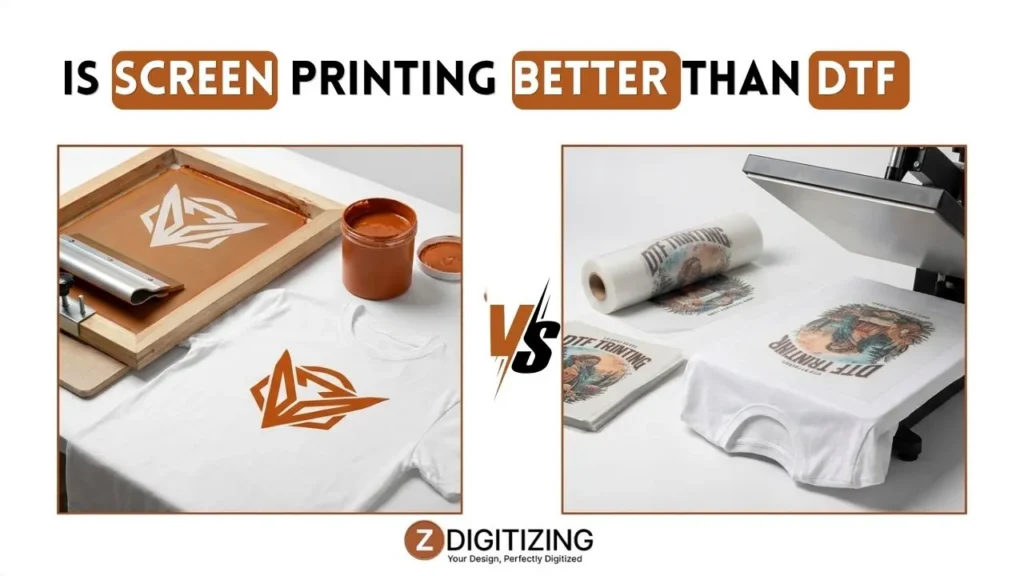
Screen printing and DTF both transfer artwork onto garments, but they use very different production methods.

Screen printing uses a separate mesh screen for each ink color. The artwork is prepared into color separations, screens are created, and ink is pushed through each screen onto the garment before curing. Because the setup is done before production begins, the process becomes more efficient when many garments use the same design.
DTF, or direct to film printing, works digitally. The artwork is printed onto a special film, adhesive powder is applied and cured, and the finished transfer is heat-pressed onto the garment. There is no traditional screen setup, so changing from one design to another is much easier.
Quick Comparison: Screen Printing vs DTF
Factor | Screen Printing | DTF |
Best for | Larger repeat orders | Small, custom, and mixed orders |
Design | Simple to moderately complex | Detailed, full-color, gradients, photos |
Color changes | Each color adds setup | No traditional screen setup |
Personalization | Less practical for individual variations | Well suited to names and numbers |
Setup | More preparation before printing | Minimal setup |
Fabric | Particularly strong on cotton and suitable blends | Works across many garment types with the right transfer and settings |
Print feel | Can be very soft, depending on ink and application | Usually has a noticeable transfer layer |
Repeat orders | Very efficient once screens are prepared | Easy to reproduce digitally |
Small quantities | Setup can make it less economical | Usually more flexible |
Large quantities | Often more cost-efficient | Production cost can increase with volume |
The right choice becomes clearer when you look at the type of order rather than simply asking which technology is newer or more advanced.
When Is Screen Printing Better Than DTF?
Asking when is screen printing better than DTF usually points directly to bulk production, especially when you are producing a larger number of garments with the same design. Once the screens are prepared, the setup cost and preparation time are spread across many garments, which can make the per-piece cost more attractive.
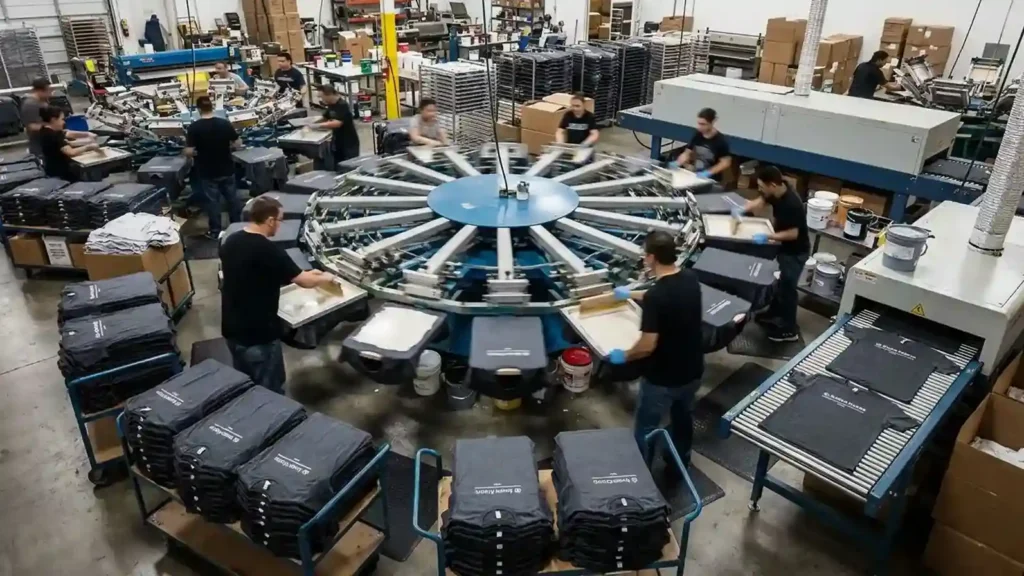
It is particularly useful for:
- Team or school apparel
- Event and promotional T-shirts
- Company uniforms
- Large merchandise orders
- Simple logos and bold graphics
- Designs using a limited number of solid colors
- Repeat orders using the same artwork
The screen printing process also gives printers access to different ink types and finishes, which can be useful when a particular print appearance or specialty effect is required.
Why Quantity Matters
The main advantage of screen printing at higher volumes is that its initial setup does not have to be repeated for every individual garment. The same screens can be used throughout the run and, when properly stored, may also be useful for future orders.
For example, printing a simple two-color logo on 100 identical shirts spreads the preparation work across the entire order. Doing the same setup for only a few shirts makes that preparation a much larger part of the total cost per garment.
That is why there is no universal number of shirts where screen printing suddenly becomes cheaper than DTF. The crossover depends on the number of colors, artwork, garment cost, labor, setup charges, and whether the screens can be reused for future orders.
When Is DTF Better Than Screen Printing?
DTF is often the more practical option when the order is smaller or the artwork would require a lot of preparation for traditional screen printing.

It works particularly well for:
- Small apparel batches
- Full-color artwork
- Photographs and detailed graphics
- Gradients and color transitions
- Personalized names and numbers
- Different designs within the same order
- Samples and product testing
- On-demand apparel production
With DTF, the artwork remains digital until it is printed onto the transfer film. This makes it easier to move between different designs without preparing a new set of screens for every variation.
This is where deciding if is DTF better than screen printing becomes less about which method produces a higher quality result and more about matching the production workflow to your specific job.
A business producing ten customized shirts with different names may find DTF far more practical than preparing screen printing setups for each variation. On the other hand, a company ordering hundreds of identical shirts with a simple logo may benefit from the efficiency of screen printing.
Is DTF Better Than Screen Printing for Detailed Designs?
When evaluating if is DTF better than screen printing for detailed designs and full-color graphics, digital transfer printing is generally the far more straightforward option. Digital printing allows the design to contain many colors, fine details, gradients, and photographic elements without requiring a separate traditional screen for every color.

Screen printing can reproduce detailed artwork as well, but complex designs may require more preparation, color separation, registration, and production steps.
For a simple one- or two-color logo, that extra preparation may not be a problem. For a highly detailed image that changes frequently, DTF can offer a much simpler production workflow.
Is Screen Printing Cheaper Than DTF?
Screen printing cost and DTF printing cost depend on more than the price of ink or transfer material. The order quantity, number of colors, artwork complexity, garment, labor, setup, and production method all affect the final price.
Screen printing can become more economical as the order gets larger because the initial setup is spread across more garments. A simple design printed on a large batch may therefore have a lower per-shirt cost than the same job produced with DTF.
DTF can be more economical for smaller orders because there is no traditional screen setup for each color. This is especially useful when the artwork contains many colors, gradients, or personalized elements.
What Changes the Cost?
Several factors can shift the balance between the two methods:
- Order quantity: More identical garments generally make screen printing more cost-efficient.
- Number of colors: Additional colors can increase screen preparation and registration work.
- Design complexity: Detailed artwork may be simpler to produce with DTF.
- Personalization: Different names, numbers, or designs favor DTF because each transfer can be prepared digitally.
- Repeat orders: Existing screens can make future screen printing orders more efficient.
- Garment type: Fabric composition and special printing requirements can affect either method.
- Labor and equipment: Production capacity and local shop pricing also influence the final cost.
So, asking whether screen printing is cheaper than DTF without specifying the order can give a misleading answer. A hundred identical two-color shirts and twenty-five personalized full-color shirts are completely different production jobs.
Screen Printing Process vs DTF Process
The production steps are one of the biggest differences between these methods.

How the Screen Printing Process Works
Screen printing begins with vector artwork prep and color separation. Similar to how Professional embroidery digitizing requires precise file preparation for needle paths, screen artwork must be cleanly separated by color before screens are burned. A separate screen is prepared for each color, and the screens must be aligned correctly before production starts.
Ink is then pushed through the prepared screens and onto the garment. After printing, the ink is cured so that it bonds properly to the fabric.
This preparation takes more work at the beginning, but once everything is set up, the same design can be printed repeatedly across a large order.
How DTF Printing Works
DTF starts with a digital artwork file rather than a set of printing screens. The design is printed onto PET film, followed by the application and curing of an adhesive powder.
The finished transfer is then positioned on the garment and applied using a heat press. Since the artwork is handled digitally, changing the design does not require creating a new screen for every variation.
This makes DTF particularly useful for short runs, custom orders, samples, and designs that contain many colors.
Screen Print vs DTF Transfer: Which Has Better Quality?
Neither method automatically produces better quality. Just like sourcing an expert embroidery digitizing service in USA ensures clean stitch density, print quality depends heavily on clean source graphics, proper curing, and printer experience.
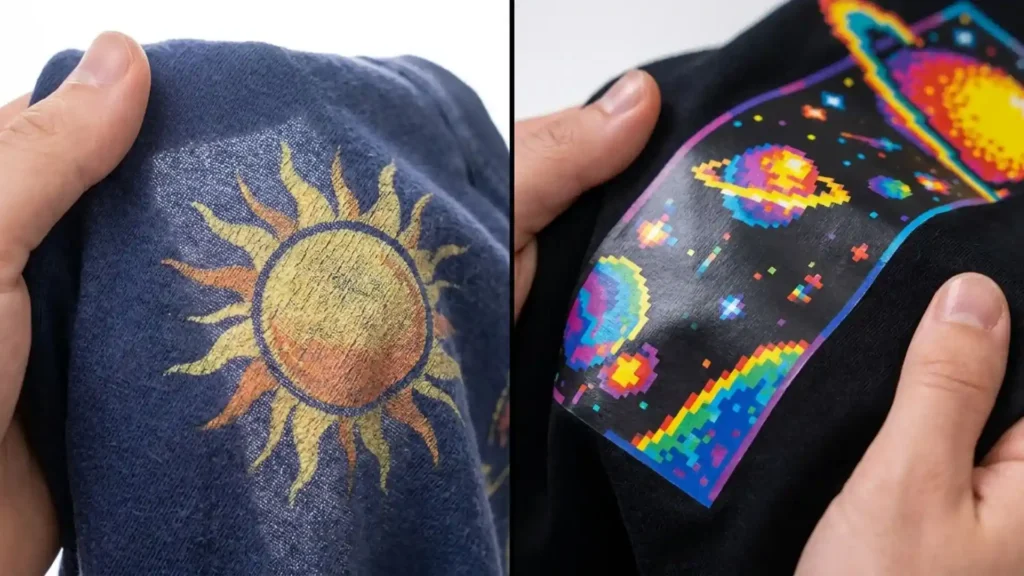
Screen printing can produce strong, vibrant graphics with a range of finishes. Water-based inks can create a softer feel, while other ink types can provide heavier coverage and different visual effects.
DTF can produce sharp details and vibrant full-color artwork, making it useful for photographs, gradients, illustrations, and designs with many color variations. However, the transfer creates a layer on top of the garment, so its feel can be more noticeable, particularly on large solid designs.
The difference is especially noticeable when comparing screen print vs DTF transfer on garments where softness and breathability matter. A smaller print may feel very different from a large, heavily covered design even when the same printing method is used.
Which Lasts Longer: Screen Printing or DTF?
Durability depends on how the print is produced and cared for, so it is not accurate to say that screen printing always lasts longer than DTF.
A properly cured screen print can remain durable through repeated washing, particularly when it is applied correctly to a suitable garment. DTF can also provide good durability when the transfer, adhesive, heat-press settings, and garment are properly matched.
Fabric makes a difference as well. A printing method that performs well on cotton may require different considerations on polyester or stretchy performance fabrics.
Washing habits also affect both methods. Following the garment and print manufacturer’s care instructions, avoiding unnecessarily harsh washing conditions, and reducing excessive heat can help preserve the print.
For this reason, DTF printing vs screen printing should be judged by the complete production setup rather than the printing technology alone.
Which Method Works Better on Different Fabrics?
Fabric choice can change the practical decision.
Screen printing has a long history of use on cotton and cotton-blend garments. Polyester can also be screen printed, but the printer may need suitable inks and techniques to reduce issues such as dye migration.
DTF is flexible across many common apparel fabrics, including cotton, polyester, and blends, provided the transfer and application settings are appropriate for the garment.
For performance wear, stretch fabrics, or synthetic garments, the specific transfer or ink system matters more than simply choosing DTF or screen printing by name.
The same principle applies to outerwear, hoodies, and fleece. Heavy garments requiring large prints, much like sourcing the best jacket back digitizing for bulky apparel, demand selecting the printing process alongside the fabric structure.
Which Printing Method Is Better for Different Orders?
The best method can change depending on what you are actually producing. Looking at the order type, design, and garment together gives a more useful answer than choosing one method for every job.

Order Type | Better Starting Point | Why |
Large T-shirt order with a simple logo | Screen printing | Setup can be spread across many identical garments |
Small batch of full-color shirts | DTF | Minimal setup and strong detail reproduction |
Team jerseys with names and numbers | DTF | Individual customization is easier |
Large school or event order | Screen printing | Efficient for many garments with the same design |
Photo or gradient artwork | DTF | Handles complex color transitions digitally |
Simple company uniforms | Screen printing | Well suited to repeat logos and larger quantities |
Small product samples | DTF | No traditional screen setup is required |
Repeat order using the same simple design | Screen printing | Existing screens can reduce preparation for future runs |
Mixed designs in one small order | DTF | Each design can be prepared digitally |
Screen Printing on Shirts
For large batches of screen printing on shirts, particularly when the same logo or graphic is repeated across every garment, screen printing can be highly efficient.
It is a strong option when the artwork uses a limited number of colors and the garments are similar. The initial preparation becomes less significant when it is distributed across a larger order.
Personalized and Small-Batch Apparel
DTF has an advantage when every garment does not need to be identical. A single order can contain different names, numbers, graphics, or even completely different designs without requiring a traditional screen setup for each variation.
That flexibility benefits small brands and custom apparel sellers. Combining on-demand printing with the best embroidery digitizing for chest logos allows shops to offer complete custom product lines without inventory risk.
Screen Printing Business vs DTF Printing Business
The better technology for a printing business depends on the customers and orders the business expects to handle.
A screen printing business is well suited to customers ordering larger quantities of consistent designs. Schools, sports organizations, companies, events, and promotional campaigns can provide the type of repeat-volume work where screen printing becomes particularly efficient.
A DTF printing business can serve customers who need smaller quantities, personalized products, detailed artwork, or fast changes between designs. It can also support businesses selling custom products without committing to large production runs.
A Hybrid Printing Business Can Make Sense
A business does not necessarily have to choose one method exclusively.
For example, a printer could use DTF for samples, small orders, personalized pieces, and complex artwork while using screen printing for larger orders with simple repeat designs.
This approach allows each process to be used where its production advantages are strongest instead of forcing every customer into the same workflow.
How to Choose Between Screen Printing and DTF
Before choosing a method, consider these five questions:
- How many garments are you producing?
Larger identical orders often favor screen printing, while smaller orders are usually more flexible with DTF. - How complicated is the artwork?
Simple logos with a few solid colors can work very well with screen printing. Photos, gradients, and highly detailed artwork are generally easier with DTF. - Does every garment have the same design?
If names, numbers, or individual designs need to change from one garment to another, DTF can simplify production. - What fabric are you printing on?
Cotton, polyester, blends, fleece, and performance fabrics can have different printing requirements. The specific ink or transfer system should match the garment. - What matters most about the finished print?
Consider softness, coverage, appearance, durability, production flexibility, and cost rather than judging the technology by one factor alone.
Once these factors are clear, the choice between DTF vs screen printing becomes much easier.
Conclusion
So, is screen printing better than DTF? For large orders with simple, repeat designs, screen printing is often the more efficient choice. For small batches, detailed full-color artwork, personalization, and flexible production, DTF is usually more practical.
Neither method replaces the other. The better option depends on the quantity, artwork, garment, customization requirements, and production priorities of the specific order.
Choosing the method based on those factors can help you avoid unnecessary setup costs while getting the print quality and finish you actually need.
To help you get your artwork print-ready, new customers receive 50% off their first embroidery digitizing & vector artwork order, ensuring seamless setup for both screen and DTF production.