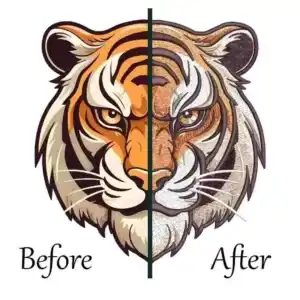
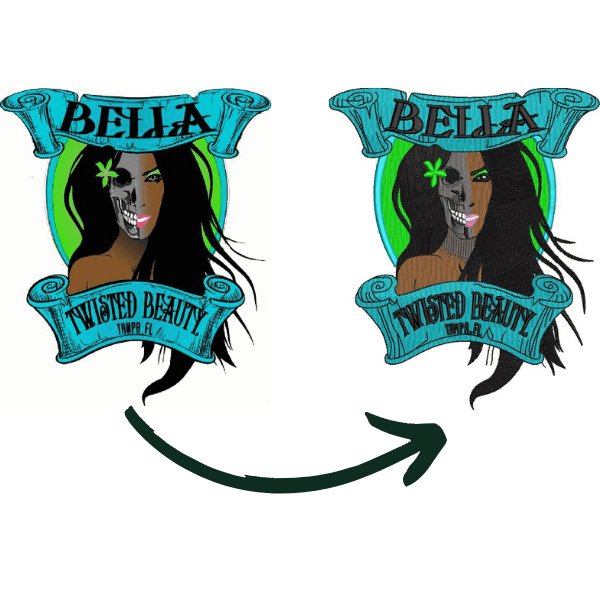
At first glance, Cheap vs Professional Embroidery Digitizing seems like an easy comparison, the lower price wins. But once that design reaches the embroidery machine, the real costs begin to show. This guide explores what actually separates a low-cost file from a professionally digitized one, so you can choose based on production results rather than price alone.

Cheap vs Professional Embroidery Digitizing
Why a Cheap Digitizing File Can End Up Costing More
Saving a few dollars on cheap embroidery digitizing sounds like a smart business decision, until that file reaches the embroidery machine. The digitizing fee is just one expense in the entire embroidery process, and it’s often not the one that has the biggest impact on your final costs. What matters more is how the file performs during every stitch of the job.
A poorly digitized file can lead to thread breaks, inaccurate registration, excessive jump stitches, or even fabric puckering. Each interruption slows production, increases operator involvement, and may require additional test runs before you can confidently start the actual order.
Hidden costs many buyers don’t consider
A low-priced file may create expenses that never appear on the invoice, such as:
- Extra machine downtime caused by repeated thread breaks.
- More time trimming unnecessary jump stitches.
- Additional test-stitch runs to correct quality issues.
- Wasted thread, backing (stabilizer), and garments.
- Delayed deliveries that affect customer satisfaction.
These costs are usually far greater than the difference between a cheap and professionally digitized file.
Expert Insight: Professional embroidery shops rarely judge a digitized file by its price alone. They judge it by how smoothly it runs on the machine. A file that stitches cleanly from the first run often saves far more in production time than the few dollars saved during ordering.
Think beyond the digitizing price
Imagine two files for the same logo.
- File A costs $8 but requires several stops during production because of poor stitch planning.
- File B costs $15 and runs smoothly from start to finish.
Even with a higher initial price, File B can help production run more efficiently by minimizing interruptions, reducing unnecessary material waste, and allowing the machine to operate with less supervision. Over multiple production runs, it often becomes the more economical choice.
Key Takeaway: The smartest comparison isn’t cheap vs. expensive, it’s upfront price vs. total production cost. A reliable embroidery file can save far more than it costs.

What Actually Makes Professional Embroidery Digitizing Different?
Not every expensive service delivers professional quality, and not every affordable service produces poor results. The real difference lies in how the embroidery file is created, not simply how much it costs.
A professional digitizer doesn’t just convert artwork into stitches. They manually plan the stitch sequence, adjust stitch density, choose the right underlay, apply pull compensation, and optimize the design for the fabric and machine it will run on. These decisions help the design stitch cleanly instead of forcing the machine operator to solve problems during production.
By contrast, some low-cost providers rely heavily on auto-digitizing or standardized settings to process files more quickly. While this approach may work for simple designs or one-time projects, it can struggle with detailed logos, small lettering, textured fabrics, or large production runs where consistency matters most.
Professional digitizing usually focuses on:
- Optimized stitch paths to reduce unnecessary trims.
- Balanced stitch density for cleaner embroidery.
- Proper underlay based on the fabric.
- Accurate pull compensation to maintain the logo’s shape.
- Fewer thread breaks and smoother machine performance.
- Files prepared for your required formats, such as DST, PES, or EXP.
Pro Tip: Before choosing a provider, ask whether the design will be hand-digitized or primarily created using auto-digitizing software. The answer often tells you more about the expected quality than the quoted price.

How to Tell If an Embroidery Digitizing Service Is Worth Paying For
Price alone won’t tell you whether a digitized file will perform well in production. A better approach is to evaluate the service based on factors that directly affect your embroidery quality, machine efficiency, and production time.
Here are the signs experienced embroidery businesses look for before trusting a new digitizing provider.
1. They Ask About Your Fabric and Design
A professional digitizer won’t start working with just your logo.
They’ll usually ask questions like:
- What fabric will this design be embroidered on?
- Is it for caps, polos, jackets, or performance wear?
- What size will the final embroidery be?
- Which embroidery machine or file format (DST, PES, EXP, etc.) do you need?
These details influence stitch density, underlay, and pull compensation. Ignoring them often leads to poor sew-outs.
Bottom Line: A digitized file that delivers clean results on a structured twill cap may not perform the same on lightweight performance fabrics unless its stitch settings are tailored to that material.
2. They Prioritize Manual Digitizing Over Automation
Modern software can speed up the digitizing process, but software alone can’t understand how different fabrics, stitch angles, or fine details behave during embroidery.
That’s why experienced providers rely on hand-digitizing to refine the design instead of depending entirely on auto-digitizing.
This becomes especially important for:
- Small lettering
- Detailed logos
- 3D puff embroidery
- Cap embroidery
- Left-chest logos with fine details
Common Mistake: Don’t assume every low-cost service uses poor methods—or that every expensive service uses hand-digitizing. Ask about their workflow before placing an order.
They Offer Revisions Instead of Leaving You With the Risk
Even well-digitized files sometimes need small adjustments after the first test-stitch. What matters is how the provider handles those revisions.
Look for services that clearly explain:
- Revision policy
- Response time
- Support after delivery
- Willingness to adjust the file if production reveals a minor issue
A provider who stands behind their work is usually more focused on long-term customer relationships than one-time sales.
Key Takeaway: A trustworthy digitizing service doesn’t just deliver a file—it supports you until that file performs reliably in production.
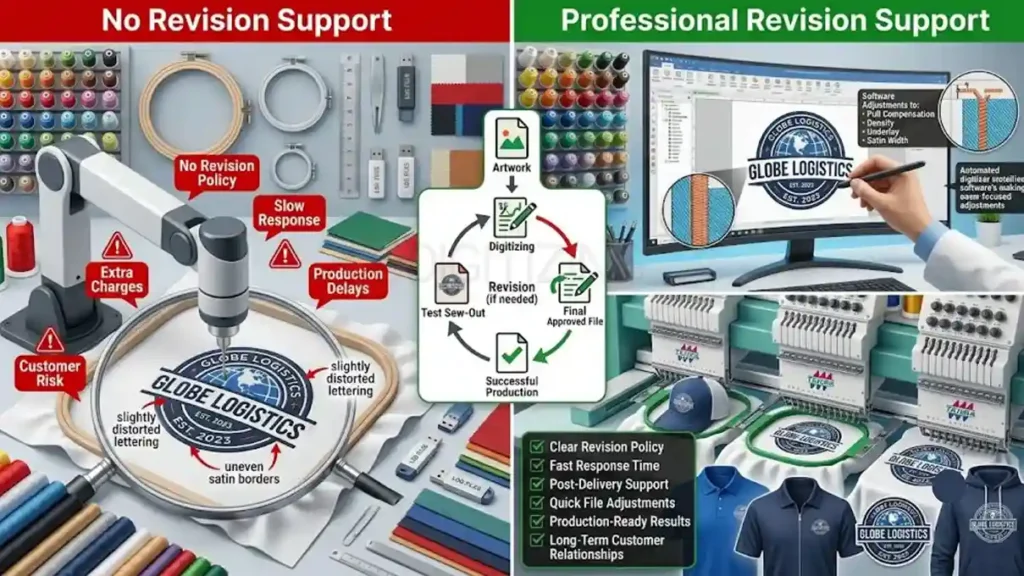
Cheap vs Professional Embroidery Digitizing — Side-by-Side Comparison
Sometimes the fastest way to understand the difference is to compare both options across the factors that matter most in real production.
Feature | Cheap Embroidery Digitizing | Professional Embroidery Digitizing |
Upfront Cost | Lower | Higher |
Hand-Digitizing | Sometimes limited or not included | Typically included for production-quality files |
Stitch Density | May use generic settings | Optimized for the design and fabric |
Underlay & Pull Compensation | Often basic or automated | Carefully adjusted for cleaner embroidery |
Thread Breaks | Higher risk on complex designs | Reduced through better stitch planning |
Test-Stitch Readiness | May require additional corrections | Designed for smoother first-run performance |
Revision Support | Can be limited or charge extra | Usually includes reasonable revisions |
Best For | Personal projects, simple logos, one-time use | Business orders, repeat production, detailed designs |
Pro Tip: If you’re producing the same logo repeatedly, don’t compare services by the price of one file. Compare them by how consistently that file performs across dozens, or even hundreds of garments.
When Cheap Embroidery Digitizing Is Actually the Better Choice
Not every project requires premium digitizing. In some situations, Cheap vs Professional Embroidery Digitizing isn’t about choosing the highest quality, it’s about choosing the option that fits your production needs.
If the design is simple and the embroidery is only being used once, paying for advanced manual adjustments may not provide much additional value.
Cheap embroidery digitizing can be a practical option when:
- You’re embroidering a simple text design or basic logo.
- The order is a small one-time run (under 20 pieces).
- The design doesn’t include small lettering or fine details.
- It’s being stitched on a stable woven fabric with minimal distortion.
- You’re creating a personal, hobby, or sample project rather than a commercial product.
In these situations, even a file created with limited manual adjustments may produce acceptable results.
Expert Insight: Many embroidery shops use lower-cost digitizing for internal samples or promotional giveaways. They reserve professional embroidery digitizing for customer orders where consistency and quality directly affect their reputation.
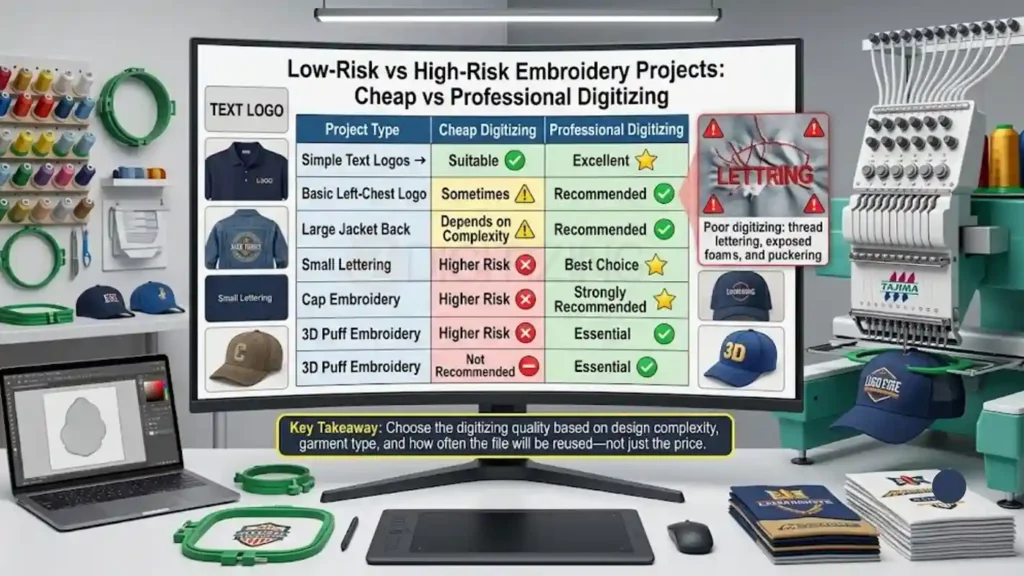
Low-Risk vs High-Risk Projects
Project Type | Cheap Digitizing | Professional Digitizing |
Simple text logos | Suitable | Excellent |
Basic left-chest logo | Sometimes | Recommended |
Large jacket back | Depends on complexity | Recommended |
Small lettering | Higher risk | Best choice |
Cap embroidery | Higher risk | Strongly recommended |
3D Puff embroidery | Not recommended | Essential |
Key Takeaway: Cheap digitizing isn’t automatically a bad choice. The right decision depends on the design’s complexity, the fabric, and how many times you’ll use the file.
When Professional Embroidery Digitizing Pays for Itself
The discussion around Cheap vs Professional Embroidery Digitizing changes completely when you’re producing embroidery for customers or repeat orders.
A professionally digitized file isn’t just about achieving cleaner stitches—it helps create a smoother production process. Better stitch paths, balanced stitch density, and proper underlay reduce the chances of thread breaks, fabric puckering, and unnecessary machine stops.
The more often a design is embroidered, the more valuable those improvements become.
Professional embroidery digitizing is usually worth the investment if you:
- Produce the same logo on a regular basis.
- Handle orders of 50, 100, or more garments.
- Embroider on challenging materials such as performance fabrics, fleece, or structured caps.
- Need clean small lettering or intricate logo details.
- Want consistent results across multiple embroidery machines.
A Simple Cost Example
Imagine you’re producing 100 embroidered polos.
- A cheap file saves $10 on digitizing.
- During production, it causes repeated thread breaks and requires two additional test-stitch runs.
- The operator spends extra time monitoring the machine, and one garment needs to be replaced.
That initial saving can disappear quickly.
Now imagine the same order with a professionally prepared file that runs smoothly from start to finish. The higher upfront cost may be recovered before the production run is even complete.
Pro Tip: If you expect to reuse a logo for future customer orders, think of digitizing as a long-term production asset rather than a one-time expense.

Questions to Ask Before Choosing Any Digitizing Service
After comparing Cheap vs Professional Embroidery Digitizing, the next step is choosing a provider you can trust. A professional-looking website or low price doesn’t always reflect the quality of the embroidery file you’ll receive.
Asking a few practical questions before placing an order can reveal far more about a provider’s expertise than their pricing alone.
Ask these questions before you order
Question | Why It Matters |
Will my design be hand-digitized or auto-digitized? | Helps you understand how much manual expertise goes into the file. |
Do you optimize the file for my fabric type? | Different fabrics require different stitch density, underlay, and pull compensation. |
Which file formats do you provide (DST, PES, EXP, JEF, etc.)? | Ensures compatibility with your embroidery machine. |
What’s included in your revision policy? | Small adjustments after a test-stitch are sometimes necessary. |
Can I see examples of similar work? | A portfolio shows experience with designs like yours. |
Do you support repeat production if I reorder later? | Important for businesses producing the same logo regularly. |
A Practical Checklist for Comparing Digitizing Services
Whether you’re evaluating cheap embroidery digitizing or investing in professional embroidery digitizing, this checklist can help you make a more confident decision.
Before placing your order, make sure the provider can offer:
- Hand-digitizing for production-quality designs when needed.
- File formats compatible with your machine (DST, PES, EXP, JEF, and others).
- A clear revision policy for minor production adjustments.
- Experience with your specific application, such as cap embroidery, left-chest logos, or jacket back digitizing.
- Files optimized for your fabric—not generic settings for every order.
- Examples of previous work with similar logo styles.
- Transparent pricing with no hidden charges for standard revisions or file formats.
- Responsive communication if production issues arise.
Conclusion
The real difference in Cheap vs Professional Embroidery Digitizing is rarely the few dollars you pay upfront. It’s the difference between a file that simply exists and a file that runs cleanly, consistently, and reliably during production. For simple one-time projects, a lower-cost option may be enough, but for customer orders, repeat runs, detailed logos, and challenging fabrics, professionally digitized files usually deliver better long-term value.
The safest way to choose a digitizing service is to evaluate how the file is created, whether it is optimized for your fabric and machine, and what support is available after delivery. Looking beyond the price tag is often what separates a smooth production run from costly rework later.
If you’re comparing providers and want a production-ready file, ZDigitizing can help with both embroidery digitizing and vector artwork for print and embroidery projects. New customers can receive 50% OFF their first order, making it easier to test the quality before committing to future production runs.